


Picture this. You unlatch your car hood after a long drive. A wave of radiating engine heat hits you, revealing a complex labyrinth of hoses, sensor wires, and fluid lines. What keeps this chaotic mechanical symphony from turning into a tangled, hazardous mess? Small, unassuming fasteners do the heavy lifting. While they might resemble everyday plastic strips found in a desk drawer, standard zip ties will catastrophically fail in the extreme heat of an engine bay. To ensure lasting security and organization, you need properly engineered automotive cable ties.
From an engineering standpoint, wire management is not just about aesthetics. It is about preventing catastrophic electrical shorts and mechanical interference. In this comprehensive guide, we will explore the critical material differences between standard and automotive-grade fasteners. Furthermore, we will delve into specialized configurations, outline essential technical specifications, and provide practical installation protocols to guarantee your vehicle systems remain safely secured.
Material Science Matters: Vehicle-specific ties utilize heat-stabilized and chemical-resistant polymers. They are explicitly engineered to survive harsh, high-vibration environments, unlike household alternatives that degrade rapidly.
Application-Specific Designs: The automotive industry relies on specialized solutions. From push-mount anchors that snap securely into chassis holes to robust stainless steel bands built for high-heat exhaust zones, precision is key.
Non-Negotiable Specs: High tensile strength, UV defense, and extreme temperature tolerance ranging from -40 degrees to 257 degrees Fahrenheit are mandatory features for automotive safety.
Installation Protocol: Correct wire routing, precise tensioning, and flush-cutting the excess tail are essential practices. These steps prevent insulation chafing and ensure long-term reliability.
Smart Sourcing: Selecting the optimal strap depends entirely on the installation zone. The engine bay, interior cabin, and exposed undercarriage dictate vastly different material requirements.
To truly understand the value of automotive-grade bindings, we must examine the specialized material science that separates them from commercial alternatives. While they may look identical to the untrained eye, the chemical composition of a vehicle-rated strap is vastly superior.
A frequent and potentially disastrous mistake made during DIY repairs is utilizing standard, off-the-shelf nylon zip ties intended for light household duty. When these generic straps are deployed in a vehicle, the results are predictably poor. Standard versions are typically molded from general-purpose Nylon 66 without any thermal stabilizers. When subjected to the relentless heat cycling of a combustion engine, the plasticizers within the material quickly evaporate. This chemical reaction causes the strap to become highly brittle. Within a matter of months, ambient heat and engine vibration will cause these inferior bands to crack and snap.
In addition, standard nylon acts somewhat like a sponge. It absorbs automotive fluids such as motor oil, power steering fluid, and ethylene glycol. This chemical attack rapidly destroys its structural integrity.
In contrast, true automotive variants are manufactured from specialized engineering polymers designed specifically to conquer these hostile conditions. Materials like heat-stabilized Nylon 66 are infused with advanced chemical additives that actively prevent thermal degradation. They are rigorously tested to survive direct, prolonged exposure to heavy grease and corrosive fluids without sacrificing flexibility or tensile strength.
Industry Trend Insight: The automotive fastener sector is currently undergoing a massive technological shift. This evolution is largely driven by the rapid expansion of electric vehicles and advanced driver-assistance systems. Modern electric vehicles require significantly more complex wiring networks to manage high-voltage battery systems and intricate sensor arrays. Consequently, engineers are seeing a surging demand for specialized wire management solutions. There is a critical need for flame-retardant cable ties that meet strict UL94V-0 standards, alongside specific color-coding like bright orange for high-voltage lines to meet stringent new safety protocols.
Feature | Standard Zip Ties | Automotive Cable Ties |
|---|---|---|
Primary Material | General-purpose Nylon 66 | Heat-stabilized Nylon 66 |
Temperature Range | Up to 185 degrees Fahrenheit | Up to 257 degrees Fahrenheit or higher |
Chemical Resistance | Low to Moderate | High resistance to oil, coolant, and fuel |
Vibration Tolerance | Poor as it becomes highly brittle | Excellent flexibility retention |
Typical Application | Office, home, light indoor duty | Engine bays, chassis, exposed undercarriage |
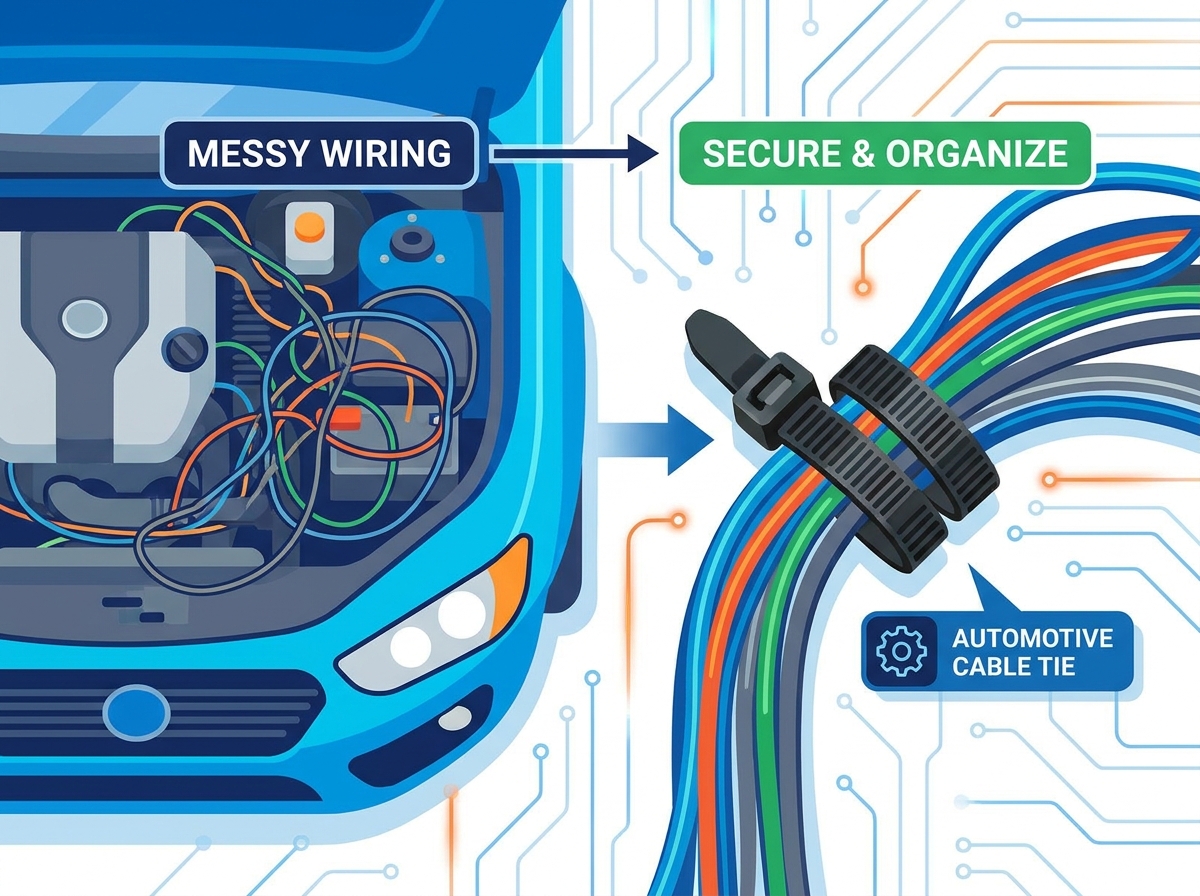
Vehicle manufacturing and aftermarket customization require far more than a simple loop mechanism. The demanding automotive environment necessitates specialized mounting solutions capable of securing components directly to the frame without causing structural damage.
Push Mount Anchor Ties
Push mount designs are among the most frequently deployed fasteners in modern assembly plants. These innovative ties feature a built-in anchoring mechanism located directly beneath the locking head. Instead of merely wrapping around a bundle of wires, the anchor is forcefully pushed into pre-drilled holes in the metal chassis or firewall. Fir tree mounts feature a ribbed, tapered shank resembling a pine tree. The flexible ribs allow the anchor to slide smoothly into a hole while fiercely resisting being pulled back out. Arrowhead mounts utilize a rigid locking mechanism that snaps definitively into a standardized hole size, frequently incorporating a tensioning disk to create a rattle-free seal.
Heat-Resistant Nylon Ties
For wiring routed near the engine block or radiator core, standard temperature limits are vastly insufficient. Heat-resistant nylon ties are explicitly engineered for these high-temperature micro-climates. Through a proprietary manufacturing process, thermal stabilizers are blended into the UL-approved Nylon 66 matrix. This empowers the fastener to maintain its mechanical grip under continuous heat stress up to 125 degrees Celsius.
Stainless Steel Bands
When anchoring components in the absolute hottest zones of a vehicle, even advanced plastics will eventually melt. For extreme-heat scenarios, stainless steel bands are the undisputed industry standard. Forged from marine-grade 304 or 316 stainless steel, these metallic bands are virtually indestructible. They utilize a unique self-locking ball-bearing mechanism rather than plastic teeth. These are absolutely essential for securing aftermarket fiberglass exhaust wraps or managing oxygen sensor wires routed directly over the exhaust manifold.
Edge Clip Designs
Routing complex harnesses along a vehicle frame presents a unique challenge when pre-drilled mounting holes are absent. Edge clip designs elegantly solve this dilemma by incorporating a heavy-duty metal or reinforced plastic clip attached directly to the tie head. These clips slide seamlessly onto the exposed edges of plastic trim pieces or welded metal chassis seams. Integrated metallic teeth bite aggressively into the edge, providing a rock-solid anchor point without the need for drilling.
When evaluating fasteners for vehicle integration, buyers must look far beyond simple length and width measurements. The underlying technical specifications ultimately determine whether a binding will survive the rigorous lifecycle of the machine.
The under-hood ecosystem of a modern internal combustion engine is exceptionally hostile. Temperatures fluctuate wildly based on ambient weather and engine load. Premium automotive straps require extreme thermal endurance. Standard operating ranges for vehicle-grade heat-stabilized Nylon 66 typically span from -40 degrees Celsius to 125 degrees Celsius. It is vital to recognize that these metrics refer to continuous operating temperatures.
Furthermore, bindings used on the vehicle exterior face relentless environmental assaults. Calcium chloride road salts deployed during winter storms can rapidly corrode inferior plastics. UV defense is critical for straps exposed to direct sunlight. High-quality exterior ties are manufactured with carbon black additives, acting as a microscopic UV shield to prevent the polymer from becoming brittle.
Tensile strength defines the maximum amount of outward stress a locking mechanism can endure before catastrophic failure occurs. In automotive scenarios, sheer durability is paramount. A standard automotive variant generally provides 50 pounds of loop tensile strength. Heavy-duty versions, however, deliver massive holding power ranging from 120 pounds to over 250 pounds. This incredible resilience is necessary for securing thick battery cables subjected to constant G-forces.
Understanding the precise applications of these fasteners empowers mechanics to select the perfect tool for their project. Proper application ensures the machine operates safely while actively preventing premature component failure.
The foremost function of these straps is managing the intricate electrical nervous system. Modern cars contain miles of wiring connecting advanced sensors and electronic control units. Bundling these individual wires into tight harnesses is absolutely critical. If wires are left dangling loosely, the natural vibration of the engine will cause them to rub aggressively against sharp metal chassis components. This constant friction chafes away the protective rubber insulation, exposing bare copper wire and triggering dangerous electrical shorts.
Beyond electrical management, these straps play a vital role in routing non-pressurized fluid lines and delicate vacuum hoses. Mechanics rely on these bindings to route soft hoses safely away from extreme heat sources and rapidly moving mechanical parts. An improperly secured coolant overflow tube could easily sag, making disastrous contact with a spinning serpentine belt.
Proper installation requires more than just pulling a piece of plastic tight. Following a methodical engineering approach ensures longevity and safety.
First, visualize and map out the entire path of your wire bundle. You must actively avoid routing cables directly over exhaust manifolds or across sharp, unpolished metal edges. Ensure the wiring path maintains a safe distance from moving mechanisms like the steering column shaft and cooling fans.
Next, match the fastener design to your specific vehicle anchor points. If you are routing along a smooth panel with pre-existing holes, select a fir-tree push mount. If you are binding a heavy battery cable to an existing structural tube, utilize a heavy-duty 120-pound strap.
Finally, wrap the strap around the bundle and pull it snug. Critically, do not over-tighten it. Crushing the wire bundle can damage delicate internal copper strands. Once properly tensioned, you must trim the excess tail correctly. Never use standard scissors or dull wire snips. Use a specialized tensioning gun or precision flush cutters to slice the plastic completely flat against the locking head. Leaving a jagged plastic tail creates a razor-sharp hazard that will inevitably slice open a mechanic during future engine maintenance.
Selecting the appropriate fastening solution is not a matter of blindly grabbing the cheapest bulk bag off a hardware store shelf. Vehicle reliability depends heavily on deploying the exact right polymer for the specific environment.
The single most crucial step is understanding exactly where the fastener will live. The interior cabin is generally shielded from harsh outdoor elements. In these climate-controlled zones, standard Nylon 66 straps are typically sufficient. The engine bay, however, is the most brutal zone for any plastic component. Here, you must exclusively deploy heat-stabilized variants. For zones near the turbocharger, transition immediately to stainless steel. The undercarriage faces relentless UV radiation and highly corrosive winter road salts, requiring powerful UV-resistant nylon.
Application Zone | Operating Temperature Range | Primary Environmental Hazards | Recommended Tie Material |
|---|---|---|---|
Interior Cabin | -40 to 85 degrees Celsius | Vibration, physical friction | Standard Nylon 66 |
Engine Bay | -40 to 125 degrees Celsius | Extreme heat, oil, coolant, grease | Heat-Stabilized Nylon 66 |
Exhaust/Turbo | Up to 537 degrees Celsius | Radiant heat, extreme thermal shock | 304/316 Stainless Steel |
Undercarriage | -40 to 85 degrees Celsius | UV rays, road salt, debris impact | UV-Resistant Nylon |
When sourcing fasteners, always verify that the products carry recognized industry certifications. Cheap imitations frequently utilize recycled regrind plastics that severely lack thermal consistency and structural integrity. Look for ties that are UL Listed and RoHS Compliant. This guarantees they have survived independent laboratory testing for flammability and extreme temperature resistance.
An automotive cable tie is far more than a simple piece of disposable plastic. It is a highly engineered, purpose-built fastener that is absolutely critical to vehicle safety, performance, and organization. The harsh realities of a combustion engine demand materials that can withstand punishing heat, corrosive chemicals, and endless vibration. Relying on cheap, generic substitutes is a direct path to catastrophic electrical failures and costly mechanical repairs.
Take a moment to evaluate your current inventory of garage fasteners. Discard those brittle household zip ties. Whether you are securing a high-voltage harness in a modern electric vehicle or routing vacuum lines in a classic restoration, you need the right polymer for the job. To ensure maximum reliability and safety, explore the professional-grade solutions at CHS Plastics. Match your specific environment to their certified, high-tensile, and heat-stabilized products to guarantee your next automotive project is built to last.
No, utilizing standard household zip ties within an engine compartment is highly discouraged. Regular versions are manufactured from standard nylon, which entirely lacks the thermal stability required for automotive environments. When exposed to the intense heat of a running engine block, these standard plastics rapidly degrade. They become extremely brittle, melt into a sticky mess, or snap entirely under pressure. Always deploy heat-stabilized automotive straps designed specifically to survive these harsh realities.
The maximum temperature threshold depends entirely on the specific material composition of the fastener. High-quality, heat-stabilized nylon straps are engineered to withstand continuous operating temperatures up to 257 degrees Fahrenheit. In zones subjected to intense radiant heat, such as directly over exhaust manifolds, any plastic will eventually fail. In these specific high-heat zones, stainless steel bands are mandatory, easily handling extreme temperatures exceeding 1000 degrees Fahrenheit without losing structural integrity.
Generally, standard automotive fasteners are designed strictly for single-use applications. This deliberate one-way locking mechanism ensures maximum security, preventing the strap from vibrating loose during heavy vehicle operation. Once tightened, the internal pawl bites permanently into the ridges of the nylon strap. While specialty releasable variants are available for temporary wiring setups, you should always rely on single-use fasteners for permanent, high-vibration installations.
A push-mount cable tie is a highly specialized automotive fastener designed to secure wire harnesses directly to the vehicle chassis or interior body panels. Instead of merely wrapping around a wire bundle, the head of the tie features an integrated mounting anchor, commonly shaped like a ribbed fir tree or a flexible arrowhead. Mechanics simply push this anchor into a pre-drilled hole in the sheet metal. The ribs lock firmly into place, providing a highly secure, vibration-resistant mount.
Properly trimming the excess tail is a critical step in automotive wiring. You must always use specialized flush cutters or a dedicated tensioning gun. These precision tools cut the plastic strap completely flush with the locking head. You should never use standard scissors or dull utility knives. Improper cutting tools leave a jagged, razor-sharp plastic edge protruding from the head, which can easily slice open a mechanic during future maintenance.
Yes, black ties are generally superior for exterior applications. High-quality black automotive ties typically contain carbon black additives. This specific chemical compound acts as a microscopic shield, providing essential UV resistance. Standard clear or white nylon ties will rapidly degrade, discolor, and become dangerously brittle when exposed to prolonged sunlight on a vehicle exterior or undercarriage.
When properly matched to their specific environmental conditions, high-quality heat-stabilized ties can last the entire lifetime of the vehicle wiring harness. However, longevity is entirely dependent on correct material selection. A standard nylon tie might fail in an engine bay within six months, whereas a properly specified UL-approved heat-stabilized Nylon 66 tie will endure decades of thermal cycling and vibration without losing its tensile strength.

