
Views: 0 Author: Site Editor Publish Time: 2026-11-21 Origin: Site


Poorly planned control cabinet layouts lead to thermal issues, extended troubleshooting times, and compliance failures during electrical inspections. Engineers often underestimate how quickly a disorganized panel becomes a severe maintenance nightmare for plant technicians. The foundation of a reliable panel layout is highly effective cable management, which heavily hinges on selecting the correct Wiring Duct for your specific environmental and electrical requirements. Without proper routing protocols, you risk severe signal interference and dangerous, localized heat buildup.
This guide breaks down the operational differences between slotted and solid designs, helping panel builders and industrial engineers finalize layouts based strictly on component density, environmental risks, and compliance standards. We help you evaluate critical material options, structural advantages, and rigid industry regulations. You will clearly learn how to optimize your next control cabinet build for maximum safety, diagnostic efficiency, and mechanical longevity.
Wire management is definitely not just an aesthetic choice; it directly impacts overall assembly time, lifecycle maintenance costs, and daily operational safety. A pristine, logical layout prevents costly wiring errors during the initial panel build. It also sets the immediate stage for reliable long-term performance across the entire machine lifecycle.
Tightly packed, disorganized wires heavily restrict natural airflow inside sealed enclosures. This restriction leads directly to localized hotspots around power supplies, step-down transformers, and variable frequency drives. Excessive ambient heat severely degrades wire insulation over time. It also drastically shortens the operational lifespan of sensitive electronic components nearby. Proper wire spacing within the channel allows natural convection to cool the entire cabinet efficiently.
Proper routing strictly ensures internal adherence to NEC and UL508A safety standards. You must carefully respect minimum bend radii to prevent internal cable stress and signal reflection. You must also observe strict maximum fill limits. The physical separation of high-voltage power lines and low-voltage signal cables remains mandatory. Field inspectors look incredibly closely at these details during site commissioning. Failing a layout inspection causes severe project delays and forces expensive rework.
Highly predictable layouts significantly reduce unplanned machine downtime. Technicians can trace electrical faults quickly when wires follow logical, highly organized paths. They never have to navigate a dangerous "rat's nest" of randomly tangled wiring. Clear routing pathways make daily maintenance safer and undeniably faster. Every single minute saved during a machine fault translates directly to higher overall production uptime.
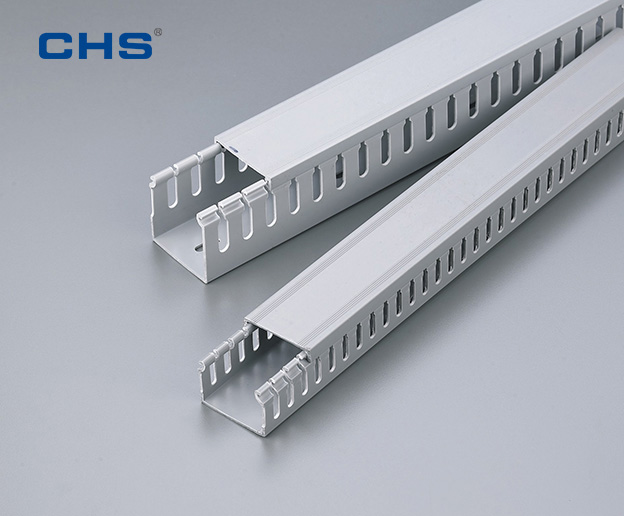
This open-finger design currently serves as the absolute primary choice for modern control panels. It is uniquely ideal for the interior of industrial enclosures featuring complex, high-density I/O configurations. Slotted Wiring Duct fundamentally excels in these demanding environments. It smoothly allows you to route hundreds of individual wires efficiently to different termination points.
Manufacturer designs allow the plastic fingers to be snapped off cleanly at dedicated score lines. This action creates customized, widened openings for routing much thicker cables. It basically allows internal wires to exit exactly where needed along the entire run. They align directly alongside terminal blocks, safety relays, and motor contactors. This precise alignment heavily reduces physical wire strain and prevents accidental terminal pull-outs.
You must actively choose between wide slot and narrow slot designs for your specific electrical build. Narrow slots are generally better for thinner, high-density signaling wires. They continuously keep small wires strictly contained inside the channel during vertical runs. Wide slots comfortably accommodate much thicker main power cables. They provide enough physical room for rigid, heavy insulation to bend safely without cracking.
This open-channel design unfortunately offers minimal physical protection against dust, high moisture, or chemical ingress. The open breakout slots permanently expose delicate wires to the surrounding cabinet environment. It is virtually never suitable for heavy washdown environments without secondary sealed enclosures. You must completely ensure your main NEMA enclosure provides the necessary comprehensive environmental defense.
Some automated applications strictly require maximum physical defense instead of fast routing flexibility. This enclosed model is best conceptually suited for long, completely uninterrupted cable runs. You frequently use it for secure connections between distinct, physically separated cabinet sections. It also works exceptionally well for routing delicate cables outside the main control enclosure along exposed machine frames.
Solid Wiring Duct provides a highly robust physical barrier against falling debris, metallic dust, and accidental tool strikes. The solid plastic walls keep harsh industrial contaminants far away from sensitive wire jackets. It delivers a highly clean, extremely professional aesthetic for any externally visible wiring runs. It completely hides the visual complexity of the bundled cables resting inside.
It inherently requires manual drilling or slow hole-sawing for any necessary cable breakouts. This mechanical requirement significantly increases your total panel installation time. It is also remarkably difficult to modify or add new cables post-installation. You cannot easily disrupt the existing, sealed run without completely removing the main protective cover. Engineering planning must be absolutely perfect before any physical installation begins.
Choosing the correct plastic compound and internal dimensions completely prevents long-term structural failures. You must carefully evaluate the end-user operating environment before ordering any bulk supplies.
Standard PVC Wiring Duct is widely the most cost-effective and common choice globally. It consistently offers excellent rigidity and superior flame-retardant industrial properties. It easily meets demanding UL94 V-0 flammability requirements, meaning it self-extinguishes almost immediately. However, enclosed confined spaces or public transit applications may strictly require halogen-free polycarbonate materials. This expensive choice entirely prevents toxic smoke generation in severe, unexpected fire scenarios.
Wiring Duct Material Comparison
| Material Category | Primary Engineering Advantage | Best Application Environment | Flammability Rating |
|---|---|---|---|
| Standard PVC | Highly cost-effective and very rigid | Standard industrial manufacturing control panels | UL94 V-0 |
| Halogen-Free Polycarbonate | Zero toxic halogen gas emission during combustion | Public transit, marine vessels, poorly ventilated spaces | UL94 V-0 / Low Smoke Zero Halogen (LSZH) |
Never mistakenly plan your internal layouts for 100% fill capacity. Design for a 50% to 60% absolute maximum fill ratio instead. This sensible approach allows adequate physical space for future expansion and proper heat dissipation. Calculate the required width and depth based strictly on the total cross-sectional area of your expected wire bundles. Always add a minimum 20% safety margin for unexpected routing modifications.
High-vibration manufacturing environments demand highly specific mechanical retention features. Heavy stamping presses or mobile mining equipment generate constant, violent shaking during operation. You absolutely require ducts featuring flush-profile, non-slip snap covers. These strong mechanical designs prevent accidental detachment during violent machine operation. A loose cover can easily fall into nearby moving machinery and cause catastrophic mechanical failures.
Even the absolute best premium materials fail quickly if you install them incorrectly. Following these proven layout strategies ensures maximum panel safety and deeply reliable long-term performance.
Never continuously run high-voltage AC power lines and low-voltage analog signal wires inside the exact same channel. You absolutely need a secure physical divider installed between them. Without it, strong electromagnetic interference will heavily corrupt your sensitive analog sensor data. If you use completely separate side-by-side ducts, ensure adequate physical air spacing between them to minimize magnetic coupling.
Carefully rely on standard DIN rail mounting systems or pre-drilled base holes for maximum security. Use industrial steel rivets or proper machine screws to secure the plastic base firmly. Avoid relying solely on cheap adhesive backing strips for primary support. Chemical adhesives degrade rapidly under normal thermal heat cycling inside busy cabinets. The loaded duct will eventually detach and fall directly onto your expensive internal components.
Follow these sequential, expert steps for highly reliable mechanical installation:
Consistently use proper plastic corner fittings for all sharp directional changes. Alternatively, carefully execute precision 45-degree miter cuts using specialized corner cutting tools. This ensures delicate small wires do not chafe heavily against any sharp plastic edges during 90-degree turns. Weak wire insulation can easily slice open on a jagged plastic corner, immediately causing a dangerous short circuit.
Finalizing your complex panel design requires correctly matching the routing style to your specific engineering constraints. Carefully use this proven logic flowchart to confidently simplify your final purchasing decision.
Audit your current electrical panel schematic carefully first. Calculate precise total wire cross-sections using standard AWG technical dimension charts. Establish your strictly required internal fill ratios directly based on regional safety codes. Select the correctly corresponding width and height dimensions before placing your final bulk order. Ensure your assembly technicians have the right specialized cutting tools ready for the upcoming assembly phase.
Choosing the correctly optimized cable routing system drastically dictates the long-term reliability of your automated control panels. The specific design you pick uniquely balances fast accessibility firmly against robust physical defense.
Finalizing these strict mechanical parameters early in the schematic phase prevents annoying physical layout bottlenecks later. It thoroughly guarantees a highly compliant, easily scalable, and incredibly professional control panel assembly build.
A: Industry best practice and NEC guidelines generally recommend not exceeding a 50-60% fill ratio to manage heat and allow for future routing.
A: While you can use standard side cutters, dedicated duct cutting tools or finger nibblers are recommended to prevent sharp edges that could slice wire insulation.
A: Halogen-free is required in poorly ventilated environments, public transport, or highly regulated facilities where toxic gas emissions during a fire pose a critical life-safety risk.
A: The best practice is to use completely separate parallel ducts. If space is limited, use a single wide duct equipped with a physical separator wall designed for EMI reduction.

