
Views: 0 Author: Site Editor Publish Time: 2026-10-31 Origin: Site


Picture this scenario. You are walking through a newly commissioned industrial facility, finalizing the bill of materials for a critical electrical routing project. You hold two seemingly identical black zip ties in your hands. Visually, they are completely indistinguishable. Yet, under the relentless vibration of heavy machinery or extreme temperature fluctuations, one snaps catastrophically. The other holds firm. Why does this happen? The answer almost always lies buried in the underlying polymer chemistry.
Nylon, technically referred to as polyamide, reigns supreme as the undisputed king of fastening materials. It offers an exceptional balance of tensile strength, toughness, and chemical resilience. However, not all polyamides are created equal. PA66, commonly known as Nylon 66, and PA6, known as Nylon 6, belong to the same polymer family. Despite this, their distinct molecular architectures lead to vastly different field performances.
This comprehensive guide will dismantle the technical differences, performance metrics, and economic factors between these two standard fastening solutions. By grasping the empirical data behind these materials, procurement managers and field engineers can make the most cost-effective and reliable choices for their specific industrial, automotive, or commercial applications.
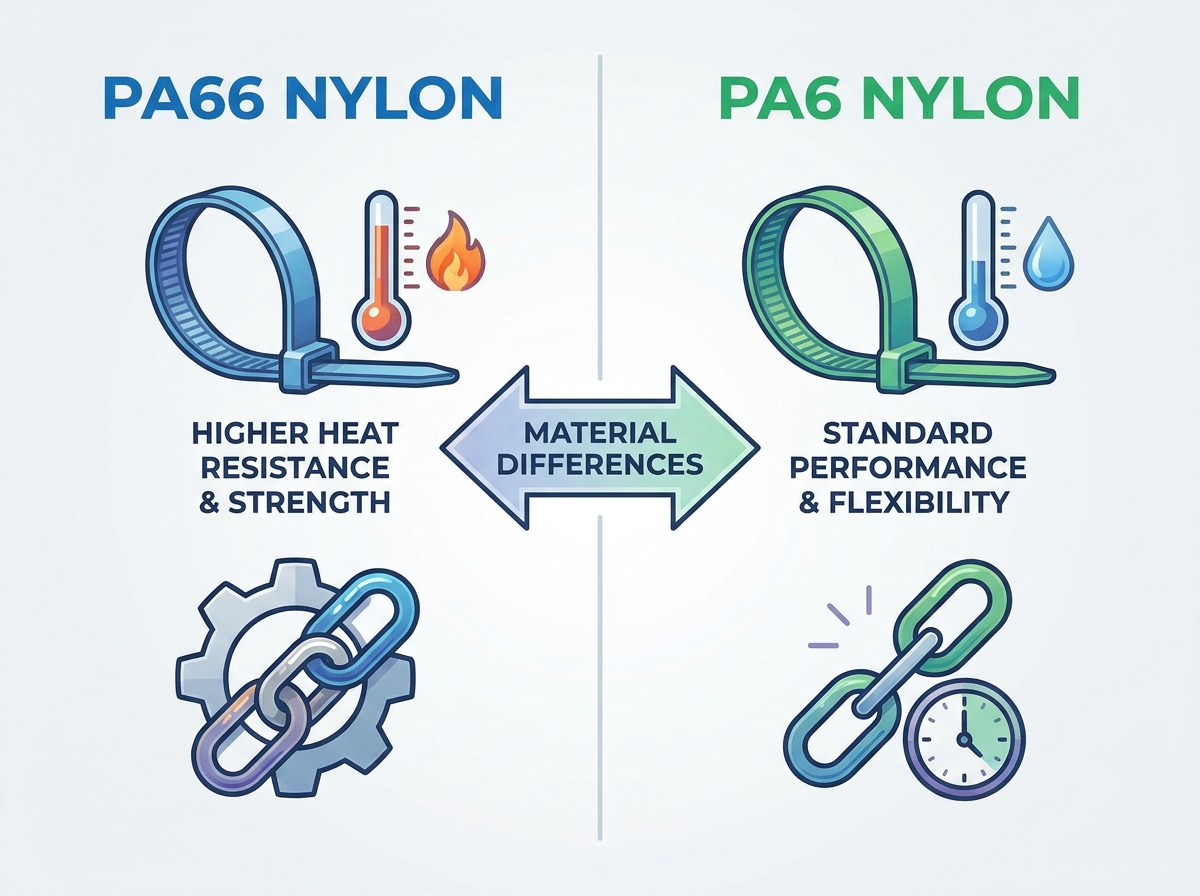
PA66 Fasteners serve as the industry standard for heavy-duty and high-temperature applications. They offer superior tensile strength, rigidity, and a significantly higher melting point.
PA6 Fasteners excel in dynamic environments requiring high flexibility and impact resistance. They feature a smoother, glossier surface finish that appeals to consumer-facing packaging.
Temperature and Moisture Dynamics: PA66 performs reliably in extreme heat. In contrast, PA6 offers enhanced toughness in cold environments due to its slightly higher moisture absorption rate, which acts as a natural plasticizer.
Selection Rule of Thumb: Procurement teams should specify PA66 for structural, electrical, and automotive applications. Conversely, PA6 is the optimal choice for consumer goods, packaging, logistics, and applications demanding high elasticity.
To understand why PA66 dominates the heavy-duty market, we must examine its chemical foundation. PA66 is a semi-crystalline engineering thermoplastic. It is synthesized from two distinct monomers—hexamethylenediamine and adipic acid. Each of these monomers contains exactly six carbon atoms. This dual-monomer synthesis creates a highly ordered, tightly packed crystalline molecular structure.
This dense molecular arrangement gives PA66 formidable mechanical strength. It exhibits excellent rigidity and outstanding resistance to wear, abrasion, and friction. When electrical contractors request a standard, high-quality zip tie, they are almost universally referring to PA66. It serves as the foundational material for strict electrical cable management systems and structural bundling worldwide.
Standard specifications for unmodified PA66 ties, such as those manufactured by CHS Plastics, typically include a continuous operating temperature range of -40 to 85 degrees Celsius. This translates to -40 to 185 degrees Fahrenheit. They also carry a UL94 V-2 flammability rating. Furthermore, their high yield strength is specifically tailored to prevent stretching under heavy static loads, with heavy-duty variants easily exceeding 250 pounds of loop tensile strength.
In contrast to its more rigid sibling, PA6 is synthesized through the ring-opening polymerization of a single monomer known as caprolactam. While it shares many fundamental properties with PA66, its unique polymer chain arrangement results in a slightly lower degree of crystallinity.
This structural variance grants PA6 its defining traits. It possesses superior elasticity, remarkable impact resistance, and a naturally glossy, premium surface finish. Specifically, PA6 has a slightly higher moisture absorption rate. In the realm of polyamides, water acts as a natural plasticizer. As PA6 absorbs trace amounts of ambient moisture from the air, it becomes increasingly resilient. It is far less prone to shattering, particularly in frigid or arid conditions.
It is vital to recognize that PA6 is not an inferior substitute for PA66. Instead, it is a highly specialized polymer engineered for dynamic mechanical stresses. In these scenarios, flexibility, vibration dampening, and shock absorption take precedence over sheer static rigidity.
To make an informed procurement decision, buyers must dive into the empirical data. The following table provides a direct, head-to-head comparison of standard, unmodified PA66 and PA6 materials based on standardized testing environments.
Performance Metric | PA66 Nylon Cable Ties | PA6 Nylon Cable Ties |
|---|---|---|
Tensile Strength | Very High. Highly rigid, resists stretching under load. | Moderate to High. More elastic, yields slightly before breaking. |
Melting Point | Approximately 255°C or 491°F. | Approximately 220°C or 428°F. |
Flexibility | Moderate. Maintains strict dimensional stability. | Excellent. Highly elastic and pliable. |
Impact Resistance | Good, but can snap under sudden, severe shock. | Superior. Absorbs blunt shock and kinetic energy well. |
Moisture Absorption | Lower. Around 2.5 percent at equilibrium. | Higher. Around 3.0 percent at equilibrium. |
Tensile strength dictates the maximum stress a fastener can endure before yielding. Thanks to its tighter crystalline lattice, heavy-duty nylon cable ties made from PA66 generally sustain higher tensile loads. If a project involves hoisting heavy steel conduits or securing structural components that exert relentless pressure on the locking mechanism, PA66 delivers the necessary dimensional stability. It prevents creep, which is the gradual, unwanted stretching of material over time.
Thermal stability often dictates the lifespan of a fastener in harsh environments. PA66 boasts a melting point hovering around 255 degrees Celsius, compared to 220 degrees for PA6. This 35-degree margin translates directly to enhanced continuous working temperatures. During rigorous high-temp testing, PA66 maintains its structural integrity and load-bearing capacity far longer when exposed to the radiant heat of engine bays, industrial ovens, or high-voltage electrical enclosures.
Where PA66 dominates in static rigidity, PA6 shines in dynamic flexibility. Imagine a scenario where bundled cables are subjected to sudden blunt shocks, continuous mechanical vibrations, or severe bending angles. Highly rigid plastics can develop micro-fractures in these environments. This eventually leads to catastrophic snapping. PA6 handles these dynamic loads exceptionally well. It stretches just enough to absorb kinetic energy without breaking the locking head.
All nylons are inherently hygroscopic. This water absorption fundamentally alters the polymer matrix. It wedges water molecules between polymer chains to increase flexibility while slightly reducing tensile strength. Because PA6 absorbs moisture at a marginally faster rate and higher capacity than PA66, it achieves its optimal toughness quicker in humid environments. Conversely, in bone-dry winter climates, standard PA66 can turn dangerously brittle. Properly conditioned PA6 retains a superior degree of impact resistance.
Recent market analyses indicate a significant shift in how these materials are deployed. This shift is heavily influenced by the rapid expansion of the electric vehicle and renewable energy sectors. As automotive manufacturers transition to high-voltage EV architectures, the demand for heat-stabilized PA66 has surged. Field engineers critically need to secure complex wire harnesses near high-temperature battery management systems without risking material degradation.
Simultaneously, the booming e-commerce and automated logistics industries have spiked the consumption of PA6 ties. High-speed automated sorting facilities require fasteners that can withstand constant vibration and the blunt impacts of conveyor systems. This use-case is perfectly suited for the elastic nature of PA6. This bifurcation in the market underscores a vital engineering principle. You must specify the right polymer for the exact operational environment, rather than relying on a traditional one-size-fits-all approach.
For enterprise procurement teams ordering millions of units, even a fraction of a cent per piece can drastically alter the bottom line. Historically, caprolactam, the raw resin for PA6, has been slightly more abundant. It is generally less vulnerable to supply chain volatility than the dual-monomer precursors required for PA66.
From a production standpoint, PA6 features a lower melting point and a broader processing window during injection molding. This translates to reduced energy consumption and faster cycle times for manufacturers. Theoretically, this drives down factory-gate costs. However, the colossal global scale of PA66 production often neutralizes this advantage for end-buyers. Since PA66 remains the universally mandated standard for electrical contracting and construction, economies of scale keep standard PA66 ties highly competitive.
If your application centers on basic consumer packaging, temporary logistics bundling, or indoor retail displays where extreme heat resistance is irrelevant, switching to PA6 for bulk orders can occasionally unlock meaningful cost savings. Yet, for critical structural compliance, the performance insurance provided by PA66 easily justifies any marginal price premium.
Understanding the chemical differences is only useful when applied to real-world scenarios. The choice between these two materials should be dictated entirely by the environmental and physical demands of your specific application.
Automotive and aerospace engineers rely on PA66 for under-the-hood wiring harnesses. Ambient temperatures routinely exceed 80 degrees Celsius in these zones, and PA66 ensures the grip remains tight without softening. Electrical contractors deem it essential for HVAC installations, electrical panel bundling, and securing rigid conduits. In these fields, strict UL compliance for strength and heat deflection is non-negotiable. Heavy construction crews also utilize it for anchoring scaffolding netting and organizing heavy industrial piping.
Packaging and logistics managers make PA6 their go-to choice for securing transit crates, heavy bags, or pallets. The ties might endure sudden drops and shifting loads during shipping, and PA6 absorbs that shock. Consumer goods manufacturers use it widely in retail products and electronics packaging. The glossy, premium aesthetic of PA6 adds visual appeal without scratching delicate surfaces. Furthermore, it is highly effective in industrial refrigeration units or cold-storage environments, as its inherent moisture-retaining toughness prevents the locking head from shattering.
While standard natural, clear or white, PA6 and PA66 are incredibly versatile, they possess inherent vulnerabilities. The most notable is rapid degradation under prolonged exposure to ultraviolet radiation. To combat this, chemical engineers compound the base resins with specialized additives to create application-specific variants.
Standard nylon will eventually turn yellow, degrade, and become brittle when bombarded by sunlight. By integrating finely dispersed carbon black into the polymer matrix, manufacturers produce UV-stabilized outdoor fasteners. This additive absorbs harmful UV rays, extending the fastener's outdoor lifespan from a few mere months to over a decade.
For environments that push standard plastics beyond their limits, heat-stabilizing additives are blended into PA66. These are typically copper salts or hindered amine light stabilizers. This modification elevates the continuous operating temperature up to 120 degrees Celsius or 248 degrees Fahrenheit. It is an absolute necessity for modern aerospace and high-performance automotive applications.
Stringent railway, marine, and data center safety codes demand UL94 V-0 flammability ratings. By incorporating halogen-free flame retardants, manufacturers can suppress fire spread and minimize toxic smoke emissions. This ensures critical infrastructure compliance while maintaining the mechanical grip of the tie.
Both PA66 and PA6 are formidable engineering thermoplastics. Yet, their subtle chemical differences dictate their ideal deployment scenarios. PA66 stands as the undisputed champion of static strength, rigidity, and high-heat endurance. This makes it the backbone of heavy industry and electrical contracting. Meanwhile, PA6 masters the art of flexibility, impact absorption, and cold-weather resilience, dominating the logistics and consumer goods sectors.
By carefully evaluating your specific load requirements, thermal environment, and dynamic stress factors, you can confidently select the perfect fastening solution. We encourage procurement teams and engineers to review their current bill of materials against this guide. Visit CHS Plastics at https://www.chsplastics.com today to request material samples, secure bulk pricing, and explore our extensive catalog of premium polyamide cable ties engineered for your exact operational environment.
Standard natural nylon will degrade under UV light. When UV radiation bombards the polymer chains, it breaks them down. This causes the tie to lose its tensile strength and turn dangerously brittle. For any outdoor application exposed to sunlight, you must specifically source UV-stabilized black ties. These contain carbon black to block ultraviolet degradation and ensure long-term reliability.
Nylon relies on a specific internal moisture content to remain flexible and durable. In frigid, dry winter air, ambient humidity plummets. This causes the nylon to leach its internal moisture into the atmosphere. Stripped of this natural plasticizer, the material becomes stiff and prone to snapping. Storing all nylon ties in sealed plastic bags with a tiny drop of water is a highly recommended industry best practice to maintain optimal performance year-round.
At the raw resin level, PA66 is generally slightly more expensive to synthesize than PA6. However, because PA66 is the globally mandated standard for the electrical and automotive industries, manufacturers produce it in staggering volumes. These massive economies of scale often compress the retail price difference to a negligible fraction. Your purchasing decision should be driven entirely by mechanical and environmental requirements rather than minor unit cost discrepancies.
Absolutely. Both Polyamide 6 and Polyamide 66 are highly recyclable engineering thermoplastics. Post-consumer and post-industrial ties can be melted down and repurposed into automotive components, synthetic fibers, or lower-grade industrial plastics. To maintain the specific material integrity, sorting facilities should ideally separate them during the recycling process before extrusion.
The lifespan depends entirely on the environment and the additives used. A standard indoor PA66 tie can last anywhere from 5 to 10 years in a climate-controlled facility. However, if a standard tie is placed outdoors in direct sunlight, it may fail in under a year. Conversely, properly specified UV-stabilized or heat-stabilized ties can maintain their structural integrity for 10 to 15 years even in harsh industrial or outdoor environments.
Tensile strength refers to the stress required to break the raw polymer material itself. Loop tensile strength is a practical engineering metric used specifically for cable ties. It measures the amount of outward force a locked tie can withstand before the locking mechanism fails or the strap breaks. When evaluating fasteners for procurement, loop tensile strength is the critical metric you must review.

