
Views: 0 Author: Site Editor Publish Time: 2026-10-01 Origin: Site


Step into a commercial blast freezer. Your breath instantly fogs in the sub-zero air. You look up and see a hazardous mess. Bundles of wires, sensor cables, and packaging lines have come undone. Why? The standard fasteners snapped under the extreme cold. This is a frustrating and potentially dangerous scenario for facility managers and maintenance crews.
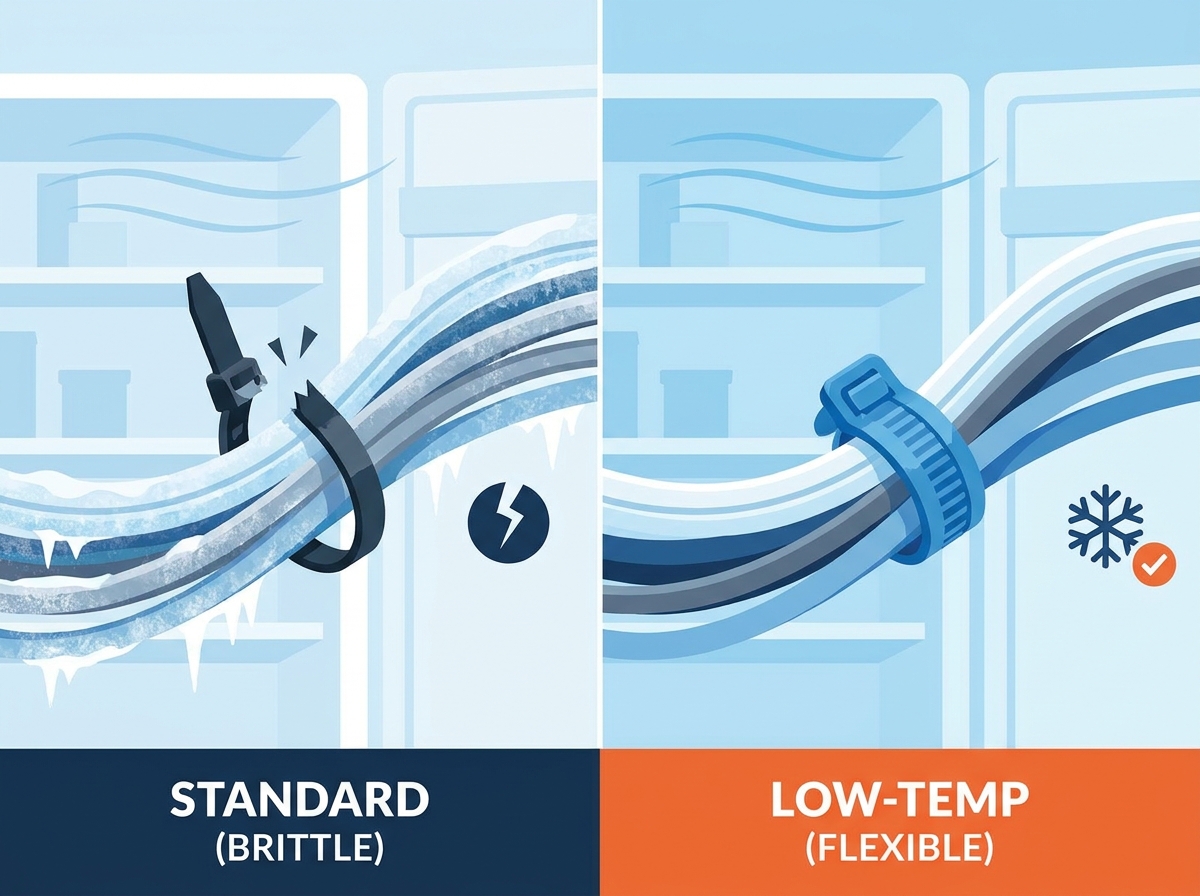
Normal nylon zip ties are not engineered for freezing temperatures. As the dry, frigid air strips away their essential moisture, they transform from flexible tools into brittle liabilities. They shatter easily under the slightest mechanical stress.
Fortunately, specialized low-temperature cable ties provide a highly engineered solution to this exact problem. Designed specifically to withstand extreme cold without compromising tensile strength or flexibility, these fasteners keep critical infrastructure secure. In this comprehensive guide, we will explore the science behind tie failure and examine the best materials for sub-zero conditions. We will also cover industry-specific solutions alongside essential installation and storage best practices to ensure the longevity of your fastening system.
Material Matters: Standard Nylon 6/6 fails in extreme cold. Specialized materials like Nylon 12, cold-weather additives, or Stainless Steel are strictly required for sub-zero environments.
Moisture is Key: Nylon relies on a precise moisture content to remain flexible. Cold freezer air acts like a sponge, stripping this moisture and causing rapid brittleness.
Installation Best Practices: Installing freezing-cold ties almost guarantees breakage. Fasteners must be kept at room temperature prior to application.
Industry Compliance: For food processing cold storage, metal-detectable ties are essential for FDA and HACCP compliance.
Proper Storage: Unused inventory must be stored in sealed plastic bags in a climate-controlled room to retain their performance-enhancing moisture content.
Facility managers frequently encounter snapped cable ties in cold storage environments. They often attribute the failure to a bad batch. However, understanding the physical and chemical reasons behind these failures is crucial for selecting the appropriate binding solutions. Standard zip ties are predominantly manufactured from Nylon 6/6. This versatile plastic performs exceptionally well in standard indoor conditions but exhibits significant structural vulnerabilities when the thermometer drops.
Every polymer possesses a specific thermal threshold known as the glass transition temperature. Above this threshold, the polymer chains possess enough kinetic energy to move freely. This internal movement allows the material to remain ductile, bendable, and capable of absorbing sudden impacts.
Conversely, when the ambient temperature drops below this threshold, the polymer chains lock into a rigid, glass-like state. For standard Nylon 6/6, this critical brittleness temperature is typically reached around -20°C. In commercial freezers, blast chillers, or outdoor winter environments, temperatures routinely plunge below this point. When a standard zip tie reaches its brittleness threshold, it completely loses its ability to flex. Any physical stress, such as the micro-expansion and contraction of bundled cables or vibration from heavy machinery, will cause the rigid plastic to shatter rather than bend.
Beyond temperature alone, the brittleness of nylon is fundamentally linked to its hydration. Nylon naturally absorbs and releases moisture from its surrounding environment. In standard formulations, water molecules act as an internal plasticizer. They lodge themselves between the polymer chains, increasing the free volume and allowing the chains to slide past one another smoothly. This internal lubrication gives a standard nylon cable tie its characteristic toughness.
Optimal flexibility requires a moisture content of approximately 2.5 percent to 3 percent by weight. Commercial freezers and cold storage facilities are inherently dry environments. As the air cools, its capacity to hold water vapor diminishes drastically. This dry, freezing air draws the essential moisture out of the nylon matrix. As the fastener dries out, it stiffens significantly. Combined with the sub-zero temperatures, this severe moisture loss pushes the material past its physical limits, resulting in catastrophic failure under minimal load.
Recent market analyses reveal a significant shift in cold chain logistics. Driven by the booming grocery delivery sector and strict pharmaceutical storage requirements, automated warehouses are becoming the new standard. Facilities can no longer afford downtime caused by snapped wire management systems.
The industry is rapidly moving away from generic consumables toward highly engineered, application-specific polymer components. Maintenance teams are now prioritizing long-term reliability over initial unit cost. This shift is driving innovations in elastomeric blends and metal-detectable technologies tailored specifically for extreme environments. Ensuring uninterrupted operation in automated blast chillers is now a top priority for modern facility design.
To combat the harsh realities of deep-freeze environments, engineers developed highly specialized fastening solutions. A true low-temperature tie is not merely a standard fastener with a thicker strap. The critical difference lies at the molecular level.
Manufacturers utilize specialized chemical compositions to fundamentally alter the physical properties of the plastic. The primary modification involves integrating cold-weather additives and impact modifiers. These elastomeric compounds blend seamlessly into the nylon matrix. Elastomers possess a much lower glass transition temperature than standard nylon, allowing them to remain pliable in extreme cold. Even if the surrounding nylon begins to stiffen, these elastomeric domains absorb impact energy and halt crack propagation. UV stabilizers are also frequently incorporated for outdoor winter applications to prevent solar degradation.
Not all cold-weather bindings are created equal. They are strictly classified based on their minimum operating temperatures. Procurement teams must carefully consult manufacturer specifications and testing standards to ensure the selected product matches their environmental demands.
Standard Cold-Weather: Modified Nylon 6/6 is typically rated down to -40°C. This is ideal for commercial freezers and outdoor winter use.
Extreme Cold: Materials like Nylon 12 or ETFE function safely between -60°C and -70°C. These are used in deep cold storage and aerospace applications.
Cryogenic: Grade 304 or 316 Stainless Steel operates comfortably at -80°C or lower. This material is designed for permanent harsh environments.
Selecting the correct material is arguably the most critical decision when sourcing cold weather bindings. The base material dictates the thermal resistance, longevity, and chemical resilience of the entire installation.
While Nylon 6/6 can be chemically modified to reach -40°C, Nylon 12 represents a massive material upgrade for extreme environments. The chemical structure of Nylon 12 features a longer hydrocarbon chain between its amide groups, making it significantly less hygroscopic.
Standard Nylon 6/6 can absorb up to 8 percent moisture by weight, whereas Nylon 12 absorbs a maximum of only 1.5 percent. Because Nylon 12 relies far less on water molecules for its flexibility, the parched air of a commercial freezer has a negligible effect on its physical properties. It remains highly stable, flexible, and resistant to stress-cracking. This makes it a premium choice for long-term cold storage applications.
For the most brutal temperature applications, plastics simply may not suffice. Grade 304 and Grade 316 Stainless Steel ties provide the ultimate fail-safe solution.
Stainless steel is entirely immune to moisture loss and does not suffer from polymer brittleness thresholds. These robust ties confidently secure heavy loads in temperatures dropping to -80°C and beyond. They offer vastly superior tensile strength and corrosion resistance, making them the gold standard for heavy cable bundles and cryogenic facilities where absolute reliability is mandatory.
In highly specialized settings such as chemical processing plants or pharmaceutical cold storage, freezing temperatures are only half the battle. Fasteners face harsh acidic washdowns or corrosive gases. Ethylene Tetrafluoroethylene is an advanced fluoropolymer designed for these precise scenarios. It maintains elasticity down to -70°C while providing exceptional resistance to chemical degradation.
Cold storage is heavily utilized within the food and beverage industry. Meat packing plants, frozen food distribution centers, and commercial bakeries operate under strict regulatory frameworks. These environments demand highly specialized fastening solutions to prevent contamination.
Food processing facilities must adhere to rigorous sanitation protocols, including FDA regulations and Hazard Analysis Critical Control Point standards. Standard nylon poses a severe contamination risk in these sensitive areas. If a clear or black plastic tie snaps due to extreme cold and falls into a processing vat, it is nearly impossible to detect visually or mechanically. This oversight leads to disastrous product recalls and consumer safety hazards.
To mitigate this massive risk, manufacturers engineer metal detectable low-temperature cable ties. During the injection molding process, the nylon matrix is evenly infused with metallic shavings or barium sulfate compounds.
This specialized formulation offers a powerful dual benefit. The base material is treated with elastomeric cold-weather additives, ensuring it survives the freezing blasts of commercial chillers without shattering. Simultaneously, the embedded metallic compounds guarantee that if a tie is accidentally severed, even the tiniest fragment will trigger standard industrial X-ray machines or metal detectors. Manufactured in a highly visible teal or blue color, these ties perfectly align with modern food safety best practices.
Implementing a reliable cable management system in sub-zero environments requires more than selecting premium materials. Even the highest-quality fasteners fail prematurely if handled incorrectly. The physical properties of both the plastics and the bundled wires change significantly in the cold. Installers must strictly avoid these critical mistakes to maintain facility safety.
A frequent error maintenance teams make is storing supplies inside the cold environment prior to application. When ties are left in a freezing warehouse overnight, the material undergoes thermal contraction and loses optimal pliability.
Attempting to bend and cinch a tie that has acclimated to sub-zero temperatures drastically increases the risk of the strap snapping right at the locking head. Inventory should always be stored in a climate-controlled room. Installers should only bring the necessary amount of ties into the freezer and apply them immediately while the plastic retains its ambient thermal flexibility.
Workers often pull ties as tightly as possible to secure heavy bundles indoors. In cold storage, this habit is a structural liability. Extreme cold causes nearly all materials to contract slightly, including the nylon tie, polymer cable jackets, and metal conduits.
If a fastener is tensioned to its absolute maximum limit at room temperature, it leaves zero tolerance for this inevitable thermal contraction. As temperatures drop, the contracting bundle exerts outward radial stress against the rigid tie, leading to micro-fractures. Installers must secure the bundle snugly to prevent slippage but deliberately leave a marginal allowance for natural physical shrinkage.
Cold environments amplify the mechanical vulnerability of plastics. This significantly reduces their impact resistance and makes them highly susceptible to abrasion.
Routing cables over sharp metal racking, unpolished conduit edges, or jagged structural supports creates concentrated stress points. In a blast freezer where constant air circulation causes slight vibrations, these sharp edges act like a blade against the stiffened nylon. Installers must meticulously inspect the routing path and utilize edge protection grommets to ensure the fastening system does not rest directly against abrasive metal.
Manual installation is highly discouraged in industrial cold storage. Workers operating in these facilities typically wear thick insulated freezer gloves. This eliminates tactile feedback and makes it impossible to gauge correct tension. Cutting the excess tail with standard side-cutters leaves a sharp, jagged edge.
Using a specialized adjustable tensioning tool is the industry best practice. These tools deliver a specific, repeatable force, completely eliminating the risk of over-tightening. High-quality tools also feature a flush-cut mechanism that cleanly severs the tail. This prevents sharp protrusions that could tear protective clothing during future maintenance.
The lifecycle of a cable tie begins long before it is wrapped around a conduit. For nylon-based products, proper storage is just as critical as the chemical composition itself. Because nylon is inherently hygroscopic, its mechanical properties are directly tied to how it is stored.
Manufacturers engineer cold-weather nylon to contain a precise moisture content, typically around 2 percent to 3 percent. This internal moisture acts as a natural plasticizer and grants the material its essential resistance to brittleness.
Industrial warehouses generally have very low ambient humidity. If a bag is opened and left exposed, the moisture rapidly evaporates from the nylon matrix. Within a matter of days, the ties dry out and become stiff. It is an operational imperative that unused inventory remains in its original factory-sealed packaging. Once a bag is opened, any remaining ties must be immediately resealed in an airtight bag to lock in the critical moisture.
Ambient storage conditions dictate the longevity of your inventory. Supplies should be kept in a climate-controlled area that maintains a consistent room temperature with roughly 50 percent relative humidity.
Facilities must ensure storage racks are positioned far away from industrial radiators, HVAC vents, or overhead lighting ballasts. These heat sources literally bake the moisture out of the plastic. Unless specifically UV-treated, standard nylon is susceptible to ultraviolet degradation and should be kept away from direct sunlight.
Maintenance teams occasionally discover a bag of ties left open, resulting in stiff, unyielding plastic. Rather than discarding the compromised inventory, industry professionals utilize a scientifically sound recovery method.
By placing the dehydrated ties into a heavy-duty airtight plastic bag, adding a few drops of clean water, and sealing it tightly for 72 hours, the internal humidity reaches maximum levels. The hygroscopic nylon naturally draws this ambient moisture back into its molecular structure. This effectively restores a significant portion of its original flexibility and tensile strength.
Procuring correct cable management materials requires a methodical evaluation of your facility's specific environmental variables. Making purchasing decisions based solely on unit cost often leads to catastrophic bundle failures, regulatory non-compliance, and expensive downtime.
Facility managers and procurement officers should utilize a structured checklist to evaluate their needs before consulting a supplier. Ensure all critical operational parameters are addressed:
Determine the Lowest Operating Temperature: The baseline metric is the absolute minimum temperature the tie will endure. A standard commercial refrigerator operating at -2°C has vastly different requirements than a blast freezer at -40°C. Verify the specific brittleness temperature rating.
Assess Environmental Hazards: Temperature is rarely the only variable. Facilities processing consumables must prioritize metal detectable nylon ties to comply with safety standards. If the environment involves chemical washdowns, consider fluoropolymers like ETFE.
Calculate Tensile Strength: Accurate measurement of the bundle diameter dictates the required length. Always over-engineer the tensile strength to accommodate ice loading and thermal contraction. If standard static loads require 50 lbs of holding force, upgrade to a heavy-duty 120 lb cable tie to absorb unpredictable environmental stresses safely.
Verify Industry Certifications: Professional-grade products undergo rigorous testing. Request documentation proving UL 62275 compliance and specific FDA approvals where applicable.
Material Type | Minimum Temperature Rating | Key Characteristics | Ideal Application Environment |
|---|---|---|---|
Nylon 12 | -40°C | Low moisture absorption, high flexibility in dry cold. | Standard commercial freezers, cold warehouses. |
Metal Detectable Nylon | -40°C | Embedded with metallic compounds for X-ray visibility. | Food processing blast chillers, pharmaceutical storage. |
Grade 316 Stainless Steel | -80°C or lower | Zero moisture dependence, extreme tensile strength. | Cryogenic facilities, permanent heavy-duty outdoor fixtures. |
ETFE | -46°C | Exceptional chemical resistance, moderate cold tolerance. | Chemical storage freezers, highly corrosive cold environments. |
Standard zip ties are an undeniable liability in cold storage and freezer environments. The physical laws governing polymer science dictate that standard nylon will inevitably lose moisture, pass its brittleness temperature, and ultimately shatter under sub-zero conditions. Investing in proper low-temperature cable ties is not merely an optional maintenance upgrade. It is a critical preventative measure.
Upgrading to specialized cold-weather materials stops catastrophic cable bundle failures, reduces costly machinery downtime, and ensures strict safety compliance. While these extreme weather ties carry a slightly higher initial procurement cost, the return on investment in durability and reduced rework is massive.
Do not wait for a critical system failure to reevaluate your infrastructure. Assess your current cold storage cable management system today. For industry-leading solutions engineered for extreme environments, explore the comprehensive catalog at CHS Plastics. Contact our engineering team for custom recommendations and secure your facility with fasteners built to survive the cold.
No. Regular nylon zip ties are not formulated to withstand sub-zero environments. The dry, freezing air inside commercial freezers rapidly strips the essential moisture content from standard Nylon 6/6. Without this moisture acting as an internal plasticizer, the material becomes highly brittle and will shatter or snap under minimal pressure, compromising your cable management system.
Standard low-temperature nylon ties, often manufactured from Nylon 12 or treated with specific cold-weather additives, are typically rated for continuous use down to -40°C. For extreme cryogenic applications or deep-freeze industrial environments, stainless steel cable ties are the superior choice, capable of withstanding temperatures as low as -80°C without experiencing any structural degradation.
Cable tie breakage in winter is caused by a combination of freezing temperatures and exceptionally low ambient humidity. Nylon is a hygroscopic material that relies on absorbed water molecules for its flexibility. The dry winter air draws this moisture out of the plastic, pushing the material past its specific brittleness temperature. Once this thermal threshold is crossed, the tie loses its elasticity and snaps under load.
While manual installation is physically possible, utilizing a professional tensioning tool is highly recommended in cold environments. Manual installation often leads to over-tightening, which leaves no room for the natural thermal contraction that occurs in freezing temperatures. An adjustable tensioning tool ensures exact, repeatable tension and provides a flush cut, eliminating jagged edges and reducing the risk of stress fractures.
Yes. Metal detectable low-temperature cable ties are specifically engineered for the unique demands of food processing cold storage. These specialized ties are infused with metallic compounds, allowing them to remain flexible in blast chillers while ensuring that any accidentally broken fragments will be reliably detected by standard food safety X-ray or metal detection scanners before reaching the consumer.
The lifespan of cold weather ties outdoors depends heavily on UV exposure and temperature fluctuations. High-quality UV-stabilized cold weather ties can last anywhere from five to ten years in harsh winter environments. Regular facility inspections are recommended to ensure structural integrity over time.
Yes, brittle nylon zip ties can often be revived. Because nylon is hygroscopic, placing dried-out ties in a sealed plastic bag with a few drops of water for a couple of days allows the material to reabsorb moisture. This simple process restores their original flexibility and prevents snapping during installation.

