
Views: 0 Author: Site Editor Publish Time: 2026-10-01 Origin: Site


Electrical cabinets function as the critical control centers of modern industrial machinery. They house essential components like programmable logic controllers, variable frequency drives, and heavy-duty power transformers. However, these densely packed enclosures are notorious for generating intense, continuous heat. Utilizing standard, commercial-grade fasteners in such demanding thermal environments is a documented engineering risk.
When exposed to extreme ambient temperatures, standard polymer plastics undergo severe thermal degradation. They rapidly lose moisture, melt, and become structurally brittle. Eventually, they snap under mechanical tension. This material failure leads to chaotic wiring, severe wire chafing against metal edges, and ultimately, dangerous short circuits. The definitive solution lies in implementing specialized fastening components designed specifically for thermal endurance.
Recent industry analyses reveal a sharp upward trend in cabinet thermal density. Driven by the rapid expansion of electric vehicle charging infrastructure and high-density industrial automation, engineers are packing more processing power into smaller physical footprints. Consequently, active ventilation systems often struggle to keep up. This shift makes thermal endurance in passive components—like wire routing accessories—more critical than ever. In this comprehensive guide, we will detail the empirical criteria needed to select the appropriate ties for extreme heat environments, analyzing material science, environmental variables, tensile sizing, and critical industry safety standards.
Material composition dictates performance: Standard nylon ties reach their thermal limit at 185°F or 85°C. Industrial high-heat environments necessitate Heat-Stabilized Nylon 6.6, fluoropolymers like TEFZEL, or industrial-grade stainless steel.
Safety and regulatory compliance: Engineers must verify UL94 flammability ratings. Prioritizing V-2 or V-0 classifications guarantees fire safety and self-extinguishing properties within enclosures.
Environmental variables matter: If the control panel operates outdoors, specifications must mandate weather-resistant materials capable of enduring both UV radiation and elevated operating temperatures.
Holistic system architecture: Fasteners function optimally when integrated into a comprehensive cable management strategy. Utilizing slotted ducts and protective tubings ensures long-term reliability.
The internal temperature of an electrical panel rarely mirrors the ambient environment of the factory floor. Components such as step-down transformers, power supplies, and variable frequency drives generate substantial thermal loads during normal operation. As engineers pack more smart devices into sealed incubators, the thermal density skyrockets. When multiple high-current devices operate with limited active ventilation, localized ambient temperatures can easily exceed 140°F or 60°C. Specific proximity hot spots can reach well over 200°F or 93°C.
Polymers react predictably to thermal stress. Standard plastics are hygroscopic, meaning they rely on a specific internal moisture content to maintain their flexibility and tensile strength. When exposed to continuous high temperatures, this moisture rapidly evaporates. As the material dries out, it transitions from a resilient state to a highly brittle one.
Picture a maintenance technician opening a cabinet door only to find heavy power cables sagging directly onto a scorching hot heatsink because the cheap plastic bindings snapped months ago. Once a fastener fails, shifting wires rub against sharp cabinet edges. This degrades the insulation over time and inevitably leads to arc faults and potential equipment fires.
In heavy industrial settings, thermal stress is rarely the sole environmental factor. Machinery generates constant low-frequency and high-frequency vibrations. The combination of thermal embrittlement and continuous mechanical shaking drastically accelerates the fatigue rate of substandard plastics. A rigid, heat-baked tie loses its ability to absorb this kinetic energy. It undergoes fatigue cracking much faster, accelerating the timeline to catastrophic system failure.
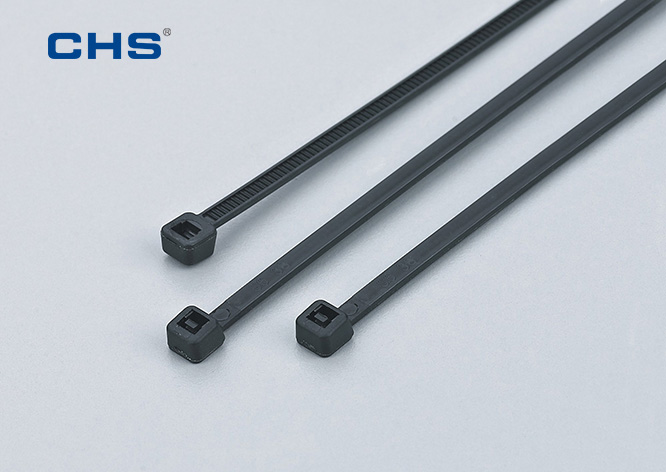
Selecting the right material is the foundation of reliable panel wiring. Below is a core comparison of industrial-grade materials engineered for thermal endurance.
Material Type | Max Continuous Temp | Key Advantage | Best Application |
|---|---|---|---|
Heat-Stabilized Nylon 6.6 | 250°F or 121°C | Excellent balance of cost and thermal resistance | Motor control centers, standard industrial panels |
Stainless Steel Grade 316 | 1000°F or 538°C | Unmatched heat and corrosion resistance | Foundries, marine environments, heavy machinery |
TEFZEL Fluoropolymer | 302°F or 150°C | Impervious to moisture and harsh chemicals | Chemical processing, aerospace wiring |
PEEK Thermoplastic | 500°F or 260°C | High dielectric strength, halogen-free | Submarine panels, extreme aerospace environments |
Standard Nylon 6.6 serves as a reliable baseline for climate-controlled environments. However, it is fundamentally insufficient for extreme industrial heat. To combat thermal degradation, manufacturers introduce proprietary chemical stabilizers during the extrusion process. This creates high-grade nylon cable ties capable of resisting the oxidation process that destroys standard plastics. Consequently, this heat-stabilized variant safely maintains structural integrity at continuous operating temperatures up to 250°F or 121°C. Due to its balance of cost and performance, it remains the industry standard for most motor control centers and HVAC equipment enclosures.
For applications where ambient temperatures obliterate the physical limits of any extruded polymer, metal becomes the definitive solution. Stainless steel bands provide unparalleled durability, withstanding continuous temperatures up to a staggering 1000°F or 538°C. Specifically, Grade 316 offers superior molybdenum-infused corrosion resistance compared to Grade 304. This makes it ideal for marine settings or foundries. To prevent rigid metal edges from slicing into softer wire insulation during installation, engineers frequently specify epoxy-coated or polyester-coated stainless variants.
TEFZEL is a specialized fluoropolymer highly engineered for environments that combine extreme heat with aggressive chemical exposure and radiation. Capable of surviving continuous temperatures up to 302°F or 150°C, this material is virtually inert. It effortlessly resists concentrated acids, bases, and organic solvents. Because it does not absorb moisture, its tensile strength remains absolute regardless of ambient humidity fluctuations. This makes it a non-negotiable requirement for nuclear power facilities and chemical processing plants.
Bridging the gap between traditional plastics and heavy metals, PEEK is an advanced, high-performance thermoplastic. It offers an extraordinary continuous operating temperature of up to 500°F or 260°C. In contrast to stainless steel, PEEK is entirely non-conductive and boasts high dielectric strength. Moreover, it is halogen-free. It will not release toxic, corrosive gases if exposed to direct flame, which is a vital safety metric for enclosed submarine or aerospace electrical panels.
Before initiating the procurement process, engineers must precisely calculate the peak ambient temperature inside the specific electrical housing. This calculation involves measuring the external ambient environment and adding the internal heat rise generated by the enclosed electronics. The chosen fastening solution must possess a continuous operating temperature rating that exceeds this calculated peak by a comfortable safety margin. A buffer of 15 to 20 percent is standard practice to account for unforeseen thermal spikes.
Tensile strength defines the maximum mechanical load a loop can endure before structural failure occurs. In panel wiring, this metric must perfectly align with the weight, gauge, and rigidity of the wire bundles. Miniature ties featuring an 18-pound rating are perfectly suited for securing thin Ethernet cables and low-voltage sensor lines. Conversely, anchoring thick 4/0 AWG power cables that exert significant mechanical force through tight bend radiuses demands heavy-duty options. These applications require products rated for 120 pounds to 250 pounds of tensile strength.
In electrical engineering, fire mitigation is an absolute prerequisite. The Underwriters Laboratories 94 standard rigorously evaluates the flammability characteristics of plastic materials. Under the UL94 V-2 classification, the material stops burning within 30 seconds, though flaming drips are permitted. However, the UL94 V-0 standard is much stricter. It requires the material to extinguish within 10 seconds with zero flaming drips. Specifying V-0 rated, self-extinguishing materials ensures that a localized short circuit will not escalate into a catastrophic facility fire.
Procuring the exact correct length prevents frustrating installation inefficiencies and material waste. The maximum bundle diameter determines the required length. Experienced installers utilize a standard formula. They multiply the bundle diameter by 3.14 and add roughly 2 inches to accommodate the locking head and provide a sufficient pulling grip. Accurate measurements ensure a secure lock without leaving excessively long tails that require tedious trimming.
High-temperature enclosures are not strictly confined to shaded factory floors. Solar inverter boxes, telecommunications arrays, and outdoor traffic control panels face a brutal dual threat. They endure immense internal heat generated by electronics alongside aggressive external weathering. When standard translucent or natural-colored plastics are exposed to direct sunlight, they undergo rapid photo-oxidation. High-energy ultraviolet photons break down the polymer chains. This causes the material to discolor, chalk, and lose its tensile strength in a matter of months.
If an electrical box is mounted outdoors, thermal endurance must be paired seamlessly with UV stability. Engineering specifications must explicitly mandate weather resistant cable ties. These are typically manufactured by infusing a minimum of 2 percent carbon black additive into the nylon resin during extrusion. This carbon black acts as a microscopic shield, absorbing solar radiation before it can damage the polymer matrix. For extreme geographical locations where brutal winter freezing intersects with high internal cabinet heat, coated stainless steel often emerges as the only viable choice.
Flawless installation technique is just as vital as meticulous material selection. A remarkably common field error is the over-tightening of fasteners. Excessive tension physically crushes the outer insulation of the wire and compresses the internal copper conductors. This alters electrical impedance and creates localized thermal hot spots. Installers should always utilize calibrated tensioning guns to ensure consistent, safe pressure. Furthermore, best practices dictate strict spatial segregation. High-voltage AC power lines must be routed completely separate from low-voltage DC communication cables to eliminate electromagnetic interference.
Relying solely on individual loop fasteners for massive industrial enclosures is highly inefficient. A holistic electrical cabinet cable management strategy utilizes slotted PVC or halogen-free wiring ducts as the primary structural spine. These ducts conceal the bulk of the wiring while allowing individual conductors to break out through the side slots exactly where they need to terminate. Fasteners are then deployed specifically to manage the breakouts and secure smaller bundles outside the main ducting pathways.
Extreme temperatures degrade not only the plastic bindings but also the wire insulation itself. This is particularly true at splice points, lugs, and terminal blocks. Where wires are stripped, environmental factors cause rapid oxidation of the exposed copper. To combat this, high-grade heat shrinkable tubings featuring a 2:1 or 3:1 shrink ratio and VW-1 flame retardant properties should be applied over all vulnerable terminations. This tubing provides essential mechanical strain relief, secondary dielectric insulation, and a robust barrier against moisture. It works in tandem with the primary anchoring ties to secure the entire wiring assembly.
A frequent procurement trap is assuming that a wider, thicker plastic strap inherently resists melting better than a thin one. Physical dimensions and thermal endurance are completely unrelated metrics. A massive 175-pound tensile strength standard nylon tie will still melt and fail at the exact same 185°F or 85°C threshold as a miniature tie. Thermal performance is dictated entirely by the chemical composition of the polymer, not its physical bulk.
In environments such as automotive manufacturing plants, CNC machining centers, or wastewater treatment facilities, control panels are routinely exposed to airborne cutting fluids, hydraulic oils, and harsh cleaning solvents. Sourcing a fastener based solely on its heat rating while ignoring chemical compatibility will lead to premature swelling and structural failure. The chosen polymer must be explicitly rated for both the thermal load and the specific chemical atmosphere.
Purchasing departments may occasionally be tempted to cut costs on wiring accessories, viewing them as generic commodity items. However, uncertified plastics lack lot-to-lot consistency and offer absolutely no guarantee of their flammability rating or thermal stability. The fleeting financial savings of utilizing substandard components are instantly negated by the catastrophic costs of machine downtime, voided equipment warranties, or an electrical fire.
Sourcing dependable components requires thoroughly vetting the credentials of the manufacturer. Professional engineers and procurement teams should exclusively partner with B2B plastics suppliers that maintain strict quality management systems. It is imperative to request technical data sheets and verify that the products carry legitimate UL listings, CE marks, and RoHS compliance. Rigorous in-house testing for tensile strength, thermal aging, and flammability ensures the product will perform flawlessly in the field.
No single fastening solution universally fits every industrial application. A reputable supplier offers a comprehensive catalog featuring multiple materials, lengths, and tensile strengths. By consulting with a specialized manufacturer, engineers can accurately match the specific thermal, chemical, and mechanical demands of their electrical enclosures with the exact high temperature cable ties required to guarantee long-term safety and operational efficiency.
Selecting the proper fasteners is a fundamental step in preventing critical system failures. Engineers must carefully evaluate maximum heat loads, environmental threats, and chemical exposures before finalizing panel designs. Material choice directly dictates long-term safety, making it essential to verify UL94 flammability ratings prior to installation. Ultimately, executing an effective cable management strategy reduces operational risks, prevents costly downtime, and protects your most valuable industrial equipment investments. For a comprehensive range of UL-certified, extreme-heat fastening solutions, explore the specialized product catalogs at CHS Plastics to find the exact match for your demanding engineering requirements.
Standard nylon ties, manufactured from basic Nylon 6.6 resin, are generally rated to withstand continuous operating temperatures up to 185°F or 85°C. For thermal loads exceeding this threshold, you must specify heat-stabilized nylon. This incorporates specific chemical additives to safely operate at continuous temperatures up to 250°F or 121°C.
No, color alone does not guarantee UV resistance. While many black ties contain carbon black to mitigate UV degradation, standard black dye is sometimes used in cheaper, indoor-only products. You must actively verify the technical specifications of the manufacturer to confirm the product is officially certified for continuous outdoor weather resistance.
Stainless steel should be mandated when ambient or internal cabinet temperatures exceed 250°F or 121°C. It is also required when the application demands extreme tensile strength over 120 pounds per tie, or when the electrical enclosure is heavily exposed to harsh corrosive chemicals, salt spray, or severe outdoor physical impacts.
They should be tensioned just enough to hold the wire bundles securely in place without sliding or shifting. They must never be tightened to the point where they pinch, deform, or crush the wire insulation. Crushing the insulation creates dangerous thermal hot spots and localized electrical resistance issues.
While it is not standard practice to apply heat shrink tubing directly over a fastened tie, both components are heavily utilized within the same wire bundle assembly. Heat shrink tubing is applied to insulate and protect wire splices and bare terminations. Ties are utilized further down the bundle to securely anchor the routed wires to the cabinet walls or ducting.
The lifespan depends entirely on the material matching the environment. A standard nylon tie in a 200°F cabinet might become brittle and snap within a few months. Conversely, a properly specified heat-stabilized nylon or stainless steel tie will maintain its structural integrity for the entire operational lifecycle of the electrical panel, often exceeding 10 to 15 years.
While colored ties are excellent for wire identification and phase coding, you must ensure they are specifically manufactured from heat-stabilized resins. Standard colored ties typically share the same 185°F thermal limit as natural nylon. Always check the technical data sheet to verify that the specific colored variant is rated for high-temperature industrial use.

