
Views: 0 Author: Site Editor Publish Time: 2026-10-26 Origin: Site


I have seen a five-cent piece of plastic bring down a fifty-thousand-dollar industrial pump system. When securing critical wiring, organizing heavy machinery components, or bundling cables for outdoor infrastructure, the reliability of your fastening solution is absolutely non-negotiable. To the untrained eye, nylon cable ties look like simple, disposable plastic strips. In reality, they are highly engineered fasteners designed to perform under strict mechanical tolerances.
Choosing cheap, low-quality binding solutions is a dangerous gamble. It leads to catastrophic equipment failures, severe safety hazards, and incredibly costly operational downtime. For procurement managers, field engineers, and serious technicians, knowing exactly how to evaluate the quality of these fasteners before making a bulk purchase is a mandatory survival skill. This guide breaks down the visual inspections, physical performance tests, industry compliance standards, and environmental evaluations you need to master. We will ensure you only invest in top-tier securing mechanisms.
Key Takeaways
Visual Cues Matter: High-quality polymer straps must feature smooth edges with zero flash, consistent coloring, and a sharply defined locking pawl.
Tensile Strength is the Gold Standard: The absolute most critical physical metric is how much dead weight the fastened loop can hold before snapping.
Material Grade Dictates Performance: Premium fasteners rely on pure, virgin Nylon 66, offering the perfect balance of structural rigidity, flexibility, and longevity.
Environmental Testing is Crucial: Zip ties must be rigorously tested for UV resistance, extreme temperature tolerance, and moisture absorption rates based on your specific application.
Always Request Samples: Conducting real-world, scenario-based sample testing is the most effective way to verify a manufacturer specification sheet.
Evaluating fastener quality goes far beyond checking if the strap looks nice. It is a foundational component of industrial risk management. Understanding the hidden, compounding costs of fastener failure in automotive, electrical, and heavy machinery applications quickly emphasizes why rigorous quality checking is critical.
In demanding environments, a single snapped zip tie triggers a chain reaction of destruction. Unspooled wires easily get caught in moving machinery. They chafe against sharp metal edges and eventually cause dangerous short circuits. Think about a commercial server room. A failed tie can restrict airflow and overheat expensive hardware. In an automotive wire harness, that same failure might lead to an electrical fire. The initial few cents saved by purchasing substandard ties evaporate instantly when you face the massive expense of emergency repairs.
Investing in premium fastening solutions significantly boosts your long-term return on investment. High-grade ties drastically reduce routine maintenance costs and replacement frequency. When a facility utilizes tested and durable fasteners, maintenance teams spend far less time diagnosing systems damaged by brittle plastic. They can finally focus on critical preventative tasks.
Using untested or inferior materials puts your entire operation in violation of strict industry safety regulations. Fasteners utilized in electrical installations, aerospace, or marine applications must meet highly specific load-bearing and flammability standards. Failing to use compliant products invites failed safety inspections and severe legal liabilities.
Before diving into complex mechanical testing inside a laboratory, you can perform an immediate quality check. You only need your eyes and hands the moment you receive a sample batch.
Look closely at the edges of the strap. Do you feel a sharp ridge? That is called flash. In the injection molding industry, flash refers to the razor-thin excess plastic that seeps out of the mold parting lines. High-quality production relies on perfectly calibrated molds and optimized clamping pressure, leaving the final product with smooth, rounded edges. If you run your fingers along the strap and feel plastic burrs, the product is poorly made. Over months of machine vibration, these sharp edges act like tiny saw blades. They will slice right through delicate wire insulation and cause painful abrasions to an assembly line worker hands.
The anatomy of the tie head ultimately determines its holding power. The internal locking tooth is technically known as the pawl. It must be cleanly molded, deeply defined, and perfectly angled to bite securely into the strap serrated grooves. Take a moment to examine the head under a bright light. If the pawl appears shallow, rounded off, or contains trapped microscopic air bubbles, the locking mechanism will likely slip the moment it is placed under tension.
The visual appearance of the polymer provides immediate clues about the raw materials. Pure, virgin Nylon 66 boasts a distinct, uniform translucency in its natural state. Cloudy, yellowish, or uneven coloring almost always indicates the use of recycled, degraded plastics. It can also point to poor thermal management during the extrusion process. For colored ties, faded or inconsistent dye distribution is a glaring red flag for inferior chemical compounding.
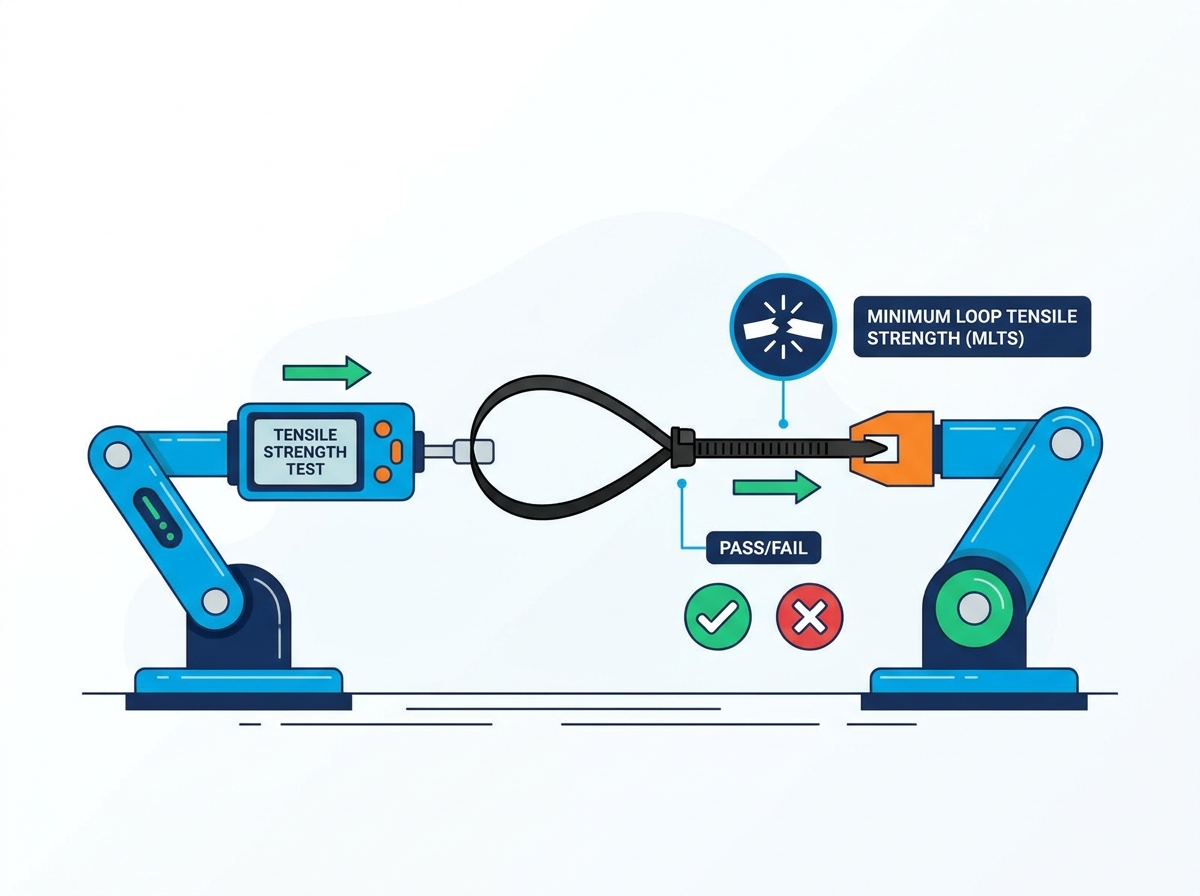
Moving beyond surface-level visual checks, the mechanical testing phase definitively proves technical reliability. This is where you verify if the manufacturer specification sheets actually hold up in the real world.
In the fastener industry, Loop Tensile Strength is the ultimate gold standard metric. It defines the absolute maximum amount of outward force a locked loop can withstand before the mechanism fails or the strap physically tears apart. Professional testing involves securing the locked tie in a specialized dynamometer. The machine pulls it apart at a constant speed to measure the exact pound-force or Newtons required to cause catastrophic failure. When sourcing heavy-duty cable ties, always demand verifiable tensile strength data.
Insertion force measures the physical effort required to thread the tail of the tie through the head and pull it tight. A premium tie is engineered with a remarkably low insertion force. It should zip smoothly and effortlessly by hand while maintaining an exceptionally high tensile strength once locked. If the insertion force is too stiff, it drastically slows down assembly operations and leads to repetitive strain injuries for workers installing hundreds of ties a day.
There must be a precise, delicate balance between flexibility and hardness. Standard hardness tests evaluate the polymer rigidity. If a tie is overly brittle due to low moisture content, it will snap the moment you bend it sharply. Conversely, if it is overly soft, the locking teeth will deform and stretch under a heavy load, eventually letting the bundled cables slip loose.
Nylon is an incredibly robust material, but harsh environmental factors inevitably degrade its molecular structure over time. Top-tier ties undergo grueling environmental simulations to ensure they survive their intended applications.
Current Industry Trend Analysis: A review of recent industrial procurement trends reveals a massive shift toward highly specialized polymers. Driven largely by the booming renewable energy market, engineers building massive solar farms and offshore wind installations are demanding ties that go far beyond standard UV resistance. There is a marked increase in demand for heat-stabilized, chemically inert nylon blends that can withstand decades of harsh environmental exposure without micro-cracking. Relying solely on generic, untested nylon is becoming obsolete for large-scale industrial applications. Modern buyers prioritize verifiable, application-specific testing data over upfront cost savings.
Standard polyamide generally operates effectively between -40 degrees Celsius and 85 degrees Celsius. In freezing conditions, untreated plastic loses its impact resistance and shatters upon a sudden strike. In extreme heat, the material softens, losing its grip and potentially melting. Reliable manufacturers conduct thermal aging tests and cold impact tests to certify structural integrity across these temperature ranges. For example, professional-grade ties are specifically formulated to maintain a UL94 V-2 flammability rating while operating safely up to 85 degrees Celsius.
Prolonged exposure to ultraviolet radiation breaks down the polymer chains in standard natural nylon. This causes it to crack and fail within just a few months. For any outdoor application, upgrading to UV-resistant black nylon cable ties is absolutely mandatory. These specialized ties are formulated with a minimum of two percent carbon black additive, which actively absorbs and disperses UV rays. Quality control involves accelerated weathering chambers that blast the ties with intense UV lamps and moisture cycles.
Because Nylon 66 is naturally hygroscopic, it constantly absorbs and releases moisture from its surrounding environment. The optimal moisture content for peak flexibility is around two and a half percent. Rigorous tests measure how these fasteners perform in highly humid environments to ensure they do not become overly soft. Chemical resistance testing evaluates how the material reacts when submerged in common industrial fluids, such as motor oils, greases, and mild cleaning solvents.
The true foundation of a reliable fastener lies hidden in its raw materials. Understanding these factors is the key to differentiating between reputable factories and cheap producers. To make selection easier, review the direct comparison below.
Material Type | Tensile Strength & Durability | Best Application Scenarios | Cost-to-Performance Ratio |
|---|---|---|---|
Virgin Nylon 66 | High strength, excellent flexibility, optimal moisture retention. | Standard electrical wiring, indoor machinery, general industrial use. | Excellent. Provides maximum reliability at a standard price point. |
Recycled Resin Blends | Unpredictable. Prone to micro-fractures and sudden snapping under load. | Lightweight, temporary DIY projects only. Never for industrial use. | Poor. Low upfront cost, but high risk of catastrophic failure. |
304/316 Stainless Steel | Extreme load-bearing capacity. Fireproof and corrosion-resistant. | Underground burial, chemical plants, offshore rigs, extreme heat zones. | Premium. High initial cost justified by permanent, fail-safe lifespan. |
Virgin Nylon 66 remains the undisputed industry standard for manufacturing high-performance cable ties. It is specifically chosen for its exceptional mechanical strength, high melting point, and excellent thermal stability. Because it is a virgin material, its long polymer chains remain completely intact. This provides the maximum possible load-bearing capacity without hidden weak points.
To aggressively slash production costs, some manufacturers secretly mix virgin nylon with recycled plastic scrap. While this lowers the price tag, it completely compromises the product. The recycling process breaks down the polymer chains and results in microscopic structural flaws. Ties injected with recycled resins suffer from unpredictable durability and a shockingly high likelihood of premature failure under stress.
When evaluating a new supplier, objective third-party certifications are your absolute best defense against dangerous products. Always demand verifiable compliance documentation.
UL Certification: UL 62275 is the primary international standard governing cable ties used in electrical installations. It ensures the fastener will self-extinguish and not act as an accelerant during a fire.
RoHS and REACH Compliance: Guarantees the fasteners are manufactured without dangerous heavy metals like lead or mercury, protecting both end-users and the environment.
CE and MIL-SPEC: For advanced applications like aerospace or defense, Military Specifications represent the highest quality tier available.
Nylon ties are cost-effective, non-conductive, and perfectly suited for the vast majority of standard industrial applications. However, specific extreme scenarios demand an upgrade. If your project involves continuous extreme heat exceeding 120 degrees Celsius, exposure to harsh corrosive chemicals, or direct underground burial, upgrading to stainless steel cable ties is an absolute necessity. Stainless steel offers unparalleled, permanent resistance to fire, radiation, and chemical corrosion.
Before committing thousands of dollars to a large-scale order, procurement managers must aggressively vet suppliers through hands-on sample testing. Relying solely on glossy marketing brochures is a massive risk.
When you receive a sample batch, do not just test them in a comfortable office. Set up a mock test that actively simulates your harshest working environment. Toss a handful of ties into a commercial freezer for twenty-four hours, then strike them against a concrete floor to simulate a winter installation drop. Suspend heavy weights from the fastened loops to verify the exact tensile strength claims. Expose them to the specific machine oils they will encounter in your facility to observe any immediate degradation.
Reputable manufacturers proudly maintain strict internal quality control laboratories. Advise your purchasing team to ask suppliers for official Certificate of Analysis documents and recent batch testing reports. These documents should detail the exact tensile strength pull tests, moisture content analysis, and dimensional tolerances of the specific batch you are about to buy.
Checking the quality of a nylon cable tie goes far beyond simply zipping one together and giving it a blind tug. By actively identifying visual red flags, demanding proper loop tensile strength metrics, and ensuring the exclusive use of virgin Nylon 66, you shield your projects from entirely preventable failures. Whether you are carefully bundling delicate fiber optic cables in a server room or securing heavy industrial piping outdoors, taking the extra time to validate manufacturer test reports guarantees you invest in a solution built to last. If you need verifiable, industrial-grade fastening solutions that meet strict UL, RoHS, and REACH standards, explore the full range of high-performance products at CHS Plastics to find the exact specifications for your next critical project.
Nylon ties degrade over time when stored improperly in dry, hot environments. If they snap easily when bent in half, look discolored or chalky, or feel unusually stiff in your hands, they have likely lost their essential moisture content. They should be immediately replaced to prevent installation failures.
Loop Tensile Strength is the exact amount of outward force that a fully locked cable tie can withstand before the locking mechanism gives out or the plastic strap breaks. It serves as the primary, most reliable indicator of overall quality and safe load-bearing capacity.
Not necessarily. High-quality UV-resistant ties are black because they are manufactured with a protective carbon black additive to block destructive UV rays. However, cheap ties are sometimes simply dyed black for aesthetic purposes and offer zero actual sun protection. Always check the manufacturer specification sheet for specific UV-resistant certifications before outdoor use.
Standard natural nylon ties will become brittle and fail within a few months of direct sunlight exposure. However, premium UV-resistant black nylon ties formulated with carbon black can last anywhere from five to ten years outdoors, depending on the intensity of the climate, temperature fluctuations, and the physical load they are bearing.
Nylon 66 is the industry standard, offering high tensile strength, excellent rigidity, and great heat resistance, making it perfect for general and heavy-duty industrial use. Nylon 12, on the other hand, absorbs significantly less moisture, making it highly resistant to cracking in extremely cold environments and better suited for specialized outdoor applications involving continuous freezing temperatures or high UV exposure.
Standard nylon cable ties are strictly designed for single-use, permanent locking applications. While you can technically pick the lock by wedging a small pin into the head to release the strap, doing so irreversibly damages the delicate locking teeth. This severely reduces the tensile strength if used again. If your project requires constant adjustments, you should purchase specifically designed releasable models instead.

