
Views: 0 Author: Site Editor Publish Time: 2025-09-03 Origin: Site


Choosing the right cable ties comes down to a few key factors. You need to match the length to your bundle size, pick a material that suits your environment, and check the tie’s strength for your project. Take a look at this quick table to see what professionals and DIYers consider most important:
Factor | Description |
|---|---|
Length | Make sure the tie fits your bundle for a secure hold. |
Environment | Think about heat, cold, chemicals, or UV that could affect durability. |
Strength | Choose a tie with enough tensile strength for your application. |
Tie Design | Select the right style for your specific cable management needs. |
Measure your bundle diameter, consider your conditions, and you’ll find cable ties that keep everything safe and organized.
Choose the right length of cable tie based on your bundle size for a secure hold.
Select materials that match your environment, considering factors like UV exposure and temperature extremes.
Ensure the cable tie has enough tensile strength for your specific application to prevent breakage.
Consider special features like reusable designs or color coding for better organization and flexibility.
Always measure your bundle diameter and check the tie's specifications to avoid common mistakes.
When you start shopping for cable ties, you’ll notice there are several options. Each type has its own strengths and best uses. Let’s break down the common types of cable ties so you can pick the right one for your project.
Tip: Always match the cable tie to your environment and application for the best results.
Here’s a quick comparison to help you see the differences:
Type of Cable Tie | Material Properties | Strength | Typical Use Cases |
|---|---|---|---|
Nylon Cable Ties | Temperature resistant, UV stable, chemical resistant | Moderate | General-purpose, electrical, automotive, outdoor |
Stainless Steel Cable Ties | Corrosion resistant, fire resistant, weldable | High | Industrial, marine, food processing, heavy-duty |
Specialty Cable Ties | Designed for specific environments | Varies | Extreme heat/cold, plenum spaces, identification |
You’ll find nylon cable ties in most toolboxes. These ties work well for bundling wires, organizing cables, and quick fixes. Nylon ties resist heat and chemicals, so you can use them indoors or outdoors. If you need extra durability, look for UV-stabilized or heat-stabilized nylon. These options last longer in sunlight or high temperatures. In electrical and automotive projects, nylon cable ties keep wires secure and prevent movement. Just remember, they can snap in very cold weather or under heavy tension. They’re not a replacement for bolts or welding, but they’re perfect for everyday jobs.
Good thermal and abrasion resistance
Easy to use for emergency repairs
Available in many sizes and colors
If you need heavy-duty cable ties, stainless steel is the way to go. These ties handle tough environments like factories, marine settings, and outdoor installations. Stainless steel cable ties resist rust, fire, and chemicals. You’ll want these for jobs that need extra strength or security. They last longer than nylon and won’t break down in harsh conditions. You can use them in places with high heat, moisture, or corrosive materials.
High strength and durability
Fire and corrosion resistant
Ideal for industrial and commercial use
Specialty cable ties solve unique problems. You’ll see heat-stabilized ties for engine bays, fire-retardant ties for safety, and marker ID ties for easy cable identification. Some specialty ties work in extreme temperatures or plenum spaces. Others, like double-headed or screw mount ties, help you organize cables in tight spots or attach bundles to surfaces. If you have a tricky project, specialty cable ties offer solutions that standard ties can’t.
Designed for specific environments
Options for identification and organization
Useful for harsh or regulated settings
Choosing between different types of cable ties depends on your project’s needs. Think about the environment, strength required, and any special features you might need.
When you start a project, you need to think about where you’ll use your cable ties. The environment plays a huge role in how long your ties last and how well they perform. If you want to choose the right cable tie, you should look at indoor versus outdoor use, chemical and UV exposure, and temperature extremes. Let’s break down each scenario so you can pick the best option for your needs.
Indoor projects usually have stable temperatures and less exposure to sunlight or moisture. You can use standard nylon cable ties for most indoor jobs. They offer good strength and flexibility for organizing wires, securing bundles, or even hanging decorations. If you want to reuse your ties, reusable cable ties work great for temporary setups or frequent changes.
Outdoor environments are much tougher. You deal with temperature swings, rain, humidity, and strong sunlight. These conditions can break down regular cable ties over time. You need to choose the right cable ties that can handle UV rays, moisture, and mechanical stress. UV-resistant nylon and stainless steel cable ties last longer outside. Stainless steel ties resist rust and corrosion, making them perfect for marine or industrial settings.
Here’s a quick table to help you compare how different materials perform indoors and outdoors:
Material | Strengths | Weaknesses |
|---|---|---|
Nylon | High tensile strength, UV resistant | Can degrade in extreme heat |
Stainless Steel | Excellent durability, corrosion resistant | Heavier, more expensive |
Polypropylene | Lightweight, cost-effective | Less UV resistance |
Tip: Always check the bundle diameter and the environment before you choose the right cable tie for your project.
When you work outside, you also need to think about mechanical stress. Heavy winds or moving parts can put extra load on your cable ties. Make sure you pick ties with enough tensile strength and weight capacity for outdoor jobs.
Temperature
Sunlight
UV Radiation
Moisture
Humidity
Some projects expose cable ties to chemicals or strong sunlight. If you work in a lab, factory, or outdoor space, you need ties that can resist these harsh conditions. Chemicals can weaken regular nylon ties, causing them to snap or lose grip. UV rays from the sun also break down plastic over time.
You should look for cable ties made from UV-resistant nylon, Nylon 12, or even stainless steel. These materials stand up to chemicals and sunlight much better than standard nylon. If you need reusable cable ties in these environments, make sure they have UV and chemical resistance.
Here’s a table showing how different materials handle UV and chemical exposure:
Material | UV Resistance | Chemical Resistance | Lifespan in Sunlight |
|---|---|---|---|
Nylon 6.6 | Moderate | Moderate | Prolonged with additives |
Nylon 12 | High | Excellent | Longer than Nylon 6.6 |
UV-resistant Nylon | High | Good | Suitable for extended exposure |
If you work in regulated environments, you should check for certifications like UL 62275, NEMA, IEC 62275, ISO 9001, RoHS, and REACH. These standards make sure your cable ties meet safety and environmental rules.
Standard/Certification | Description | Key Features |
|---|---|---|
UL 62275 | North American standard for cable ties | Tensile strength, temperature ratings, flammability, UV resistance |
NEMA | Classification system for cable ties | Types based on performance (General Purpose, Weather Resistant, etc.) |
IEC 62275 | International standard for cable ties | Consistency across borders, covers cable ties and mounting devices |
ISO 9001 | Quality management standard | Focus on quality management systems and customer satisfaction |
RoHS | Environmental regulation | Limits hazardous substances in materials |
REACH | Chemical regulation | Registration and restriction of chemicals in products |
Note: Environmental regulations require materials that can endure UV exposure, chemical resistance, and temperature changes. If you use the wrong material, your cable ties may fail early and create safety risks.
Temperature extremes can make or break your cable ties. If you work near engines, heaters, or in freezing weather, you need ties that can handle the heat or cold. Standard nylon cable ties work well in moderate temperatures, but they can get brittle in the cold or soften in high heat.
You should look for heat-stabilized nylon, Nylon 12, polyester, or even ETFE (Tefzel) for extreme temperatures. Stainless steel cable ties work in very hot or cold places, but they cost more and weigh more. Cold weather ties stay flexible in freezing conditions, so you can use them for outdoor winter projects.
Check out this chart to see the temperature ranges for different cable tie materials:
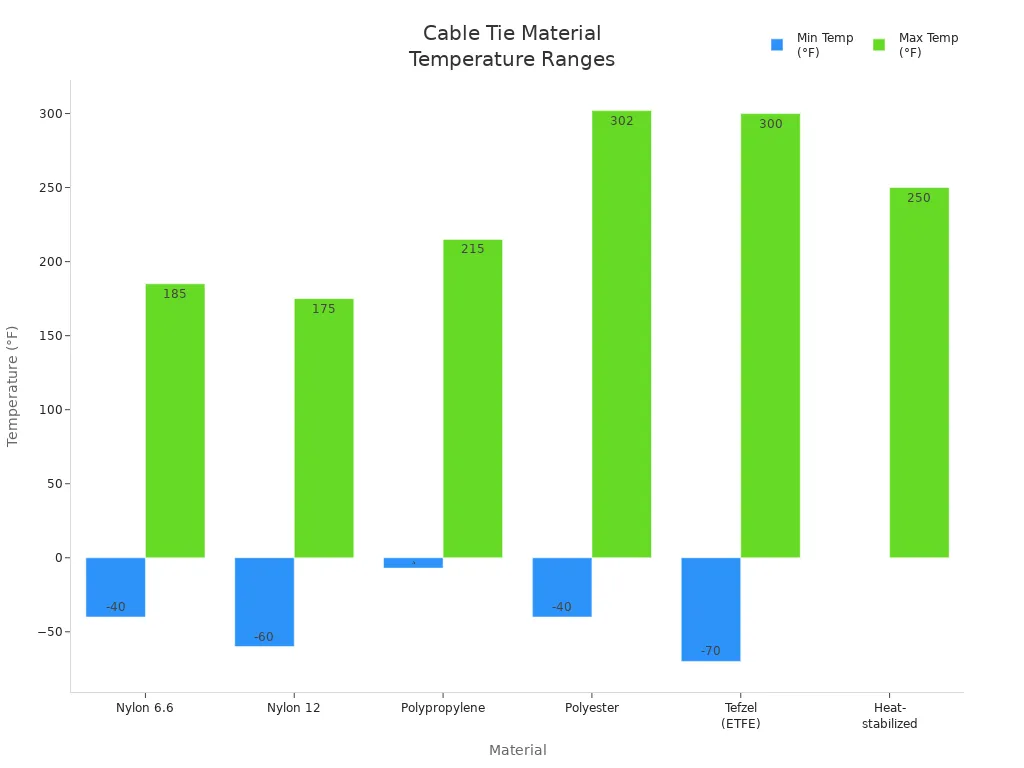
Here’s a table for quick reference:
Material | Temperature Range (°F) | Temperature Range (°C) |
|---|---|---|
Nylon 6.6 | -40 to 185 | -40 to 85 |
Nylon 12 | -60 to 175 | -51 to 79 |
Polypropylene | -7 to 215 | -21.6 to 102 |
Polyester | -40 to 302 | -40 to 150 |
Tefzel (ETFE) | -70 to 300 | -56.7 to 149 |
Heat-stabilized | Up to 250 | Up to 121 |
Cold Weather Ties | Designed for cold | More flexible in freezing conditions |
If you need reusable cable ties for high heat or cold, make sure they’re rated for the right temperature range. Some materials, like ETFE and stainless steel, work in extreme conditions and resist chemicals and UV rays.
Here’s another table showing how different materials perform under stress:
Material | Temperature Range | UV Resistance | Chemical Resistance |
|---|---|---|---|
Heat Stabilized Nylon | -40°F to 221°F | Moderate | Moderate |
UV-Stabilized Nylon | N/A | High | Low |
Nylon 12 | N/A | Moderate | High |
ETFE (Tefzel®) | -112°F to 302°F | High | High |
Stainless Steel | -328°F to 1000°F | N/A | High |
If you want your cable ties to last, always match the material to your environment. This helps prevent failures and keeps your project safe.
Assess indoor or outdoor use
Check for chemical or UV exposure
Review temperature extremes
Look for certifications if needed
Pick reusable cable ties for flexible setups
When you choose the right cable ties, you protect your cables, equipment, and even your safety. Take a few minutes to review your environment and project needs. You’ll find the right cable tie for every job, whether you’re working inside, outside, or in tough conditions.
Choosing the right cable tie size and strength is the key to safe and reliable cable management. If you get this step wrong, you might end up with loose bundles, broken ties, or even damaged equipment. Let’s walk through how you can measure, select, and compare cable ties for your project.
Before you pick out cable ties, you need to know the diameter of your cable bundle. This step helps you avoid buying ties that are too short or too long. Here’s a simple way to measure your bundle:
Grab a measuring tape or caliper. Wrap it around the cables you want to bundle.
If you haven’t bundled the cables yet, estimate the diameter by grouping them together and measuring across the widest point.
Add a little extra to your measurement—usually 20-30%—to make sure the cable tie fits comfortably and allows for easy installation.
Tip: Always round up your measurement. If your bundle measures 2 inches, choose a cable tie that can handle at least 2.5 inches.
Here’s a quick table to help you match bundle diameter to cable tie size:
Bundle Diameter (inches) | Recommended Cable Tie Length (inches) | Typical Applications |
|---|---|---|
Up to 1 | 4 | Small electronics, home use |
1 – 2 | 6 – 8 | Computer cables, office setups |
2 – 3 | 8 – 12 | Automotive, light industrial |
3 – 4 | 14 – 18 | Heavy-duty, outdoor bundles |
4+ | 18+ | Large industrial, commercial |
If you’re working with odd-shaped bundles or need extra slack, go for a longer cable tie. You can always trim the excess after installation.
Cable tie strength matters more than you might think. If you use ties that are too weak, they can snap under pressure. If you use ties that are too strong, you might damage delicate wires. You need to match the cable tie strength to your expected load.
When you select cable ties, look for the tensile strength rating. This number tells you how much force the tie can handle before breaking. For most projects, you want a safety margin of 20-30% above your expected load. For example, if you expect your bundle to weigh 100 lbs, choose a cable tie rated for at least 120 lbs.
Here’s a table showing common tensile strengths and their best uses:
Cable Tie Strength (lbs) | Suitable Bundle Diameter (inches) | Best For |
|---|---|---|
18 – 30 | Up to 1 | Light cables, home electronics |
40 – 50 | 1 – 2 | Office, automotive, small tools |
75 – 120 | 2 – 4 | Industrial, outdoor, heavy-duty |
175+ | 4+ | Large bundles, commercial use |
Note: Always check the manufacturer’s specs for cable tie strength. Don’t guess—using the wrong rating can lead to failure.
You might think cable tie length is the only thing that matters, but width plays a big role too. Wider cable ties offer more strength and stability. Narrow ties work well for small bundles and tight spaces. If you need extra holding power, go for a wider tie.
Here’s how you can match cable tie width and length to your project:
Cable Tie Width (inches) | Typical Length (inches) | Best Use Cases |
|---|---|---|
0.10 – 0.14 | 4 – 8 | Small wires, electronics |
0.18 – 0.25 | 8 – 12 | Office, automotive, general use |
0.30 – 0.50 | 14 – 24 | Industrial, outdoor, heavy-duty |
0.50+ | 24+ | Large bundles, commercial jobs |
If you’re bundling cables in a high-vibration area, choose a wider tie for extra security. For delicate wires, stick with narrow ties to avoid crushing or damaging the insulation.
Many people make simple mistakes when choosing cable tie size and strength. Here are a few to watch out for:
Picking standard nylon ties for outdoor jobs. These can break down under UV light and harsh weather.
Applying too much or too little tension. Overtightening can damage cables, while undertightening can cause bundles to loosen.
Ignoring UV exposure. Even weather-resistant ties can deteriorate over time if exposed to sunlight.
Overlooking abrasion risks. Rough surfaces can wear down cable ties and cause them to fail early.
Buying low-quality ties. Cheap ties often lack the strength and resistance needed for tough environments.
Pro Tip: Always buy cable ties from trusted brands. Look for ratings and certifications to make sure you get reliable performance.
Here’s a handy table to help you compare cable tie size, strength, and application:
Cable Tie Size (Length x Width) | Bundle Diameter (inches) | Tensile Strength (lbs) | Application |
|---|---|---|---|
4" x 0.10" | Up to 1 | 18 | Electronics, small wires |
8" x 0.18" | 1 – 2 | 40 | Office, automotive |
12" x 0.25" | 2 – 3 | 50 | Light industrial |
18" x 0.30" | 3 – 4 | 120 | Heavy-duty, outdoor |
24" x 0.50" | 4+ | 175+ | Large bundles, commercial |
If you follow these steps, you’ll always pick the right cable tie for your project. Measure your bundle, check the cable tie size, and match the strength to your needs. You’ll avoid common mistakes and keep your cables safe and secure.
When you look beyond basic cable ties, you’ll find a range of special features that can make your project easier, safer, and more organized. These options help you tackle unique challenges, whether you’re working on a quick fix or a large-scale installation.
Here’s a quick comparison to help you choose the right style for your needs:
Feature/Style | Best For | Key Benefits |
|---|---|---|
Releasable/Reusable | Temporary setups, prototyping, events | Flexible, easy to adjust, cost-effective |
Mountable | Data centers, automotive, wall mounting | Secure bundles to surfaces, tidy installations |
Marker/ID Ties | Network, electrical, industrial projects | Easy cable identification, reduces confusion |
Color Coding | Large projects, home theaters, offices | Quick device identification, visual sorting |
Heavy Duty/Metal | Automotive, aerospace, harsh environments | High strength, thermal and chemical resistance |
You might need to adjust your cables often or set up temporary installations. Releasable and reusable cable ties give you flexibility for changing needs. You can open and close them without tools, which saves time and reduces waste. These ties work well for prototyping, events, or any project where you expect changes. You also avoid the risk of cutting yourself with sharp tools.
Flexibility for changing cable management needs
Easy to use with a release mechanism
Cost-effective by reducing waste from single-use ties
Suitable for temporary installations and projects requiring adjustments
Avoidance of cutting tools, enhancing safety
Mountable cable ties let you secure bundles to walls, racks, or panels. You’ll see these in data centers, cars, and industrial settings. Marker ties include a space for labeling, so you can identify cables at a glance. This feature helps prevent mistakes and saves time during maintenance.
Industry | Cable Tie Type | Special Features |
|---|---|---|
Aerospace | Heavy duty metal, nylon | Thermal tolerance, UV and heat stabilization |
Automotive | Stainless steel | Resistant to fuel, grease, oil, extreme heat |
Color-coded cable ties make large projects much easier to manage. You can assign colors to devices or cable types, so you know exactly what goes where. Adding labels boosts identification even more. This method keeps your setup organized and reduces troubleshooting time.
Quickly identify which cord matches each device
Use labels for even clearer identification
Tip: Eco-friendly cable ties made from recycled or biodegradable materials are now available. Some even include smart sensors to monitor tension and conditions, which can improve safety and efficiency.
Getting the most out of your cable ties starts with a good installation. If you want a secure and tidy bundle, follow these steps:
Gather your materials. You’ll need cable ties, wire cutters, and a clean workspace.
Prepare your cables by untangling and straightening them.
Choose the right size cable tie for your bundle.
Loop the tie around your cables and pull it snug, but don’t overtighten. You want a firm hold without crushing the wires.
Trim off any extra length for a neat finish.
Arrange your cables along the path you want them to follow.
Give everything a quick check. Make sure the cables aren’t pinched and the ties feel secure.
Tip: Always test your installation before you finish up. A gentle tug can help you spot any loose ties or stressed cables.
You want your project to be safe for both you and your equipment. Here are some important safety tips:
Safety Protocols | Description |
|---|---|
Training and PPE | Make sure you know how to use tools and wear gloves or eye protection. |
Regular Safety Inspections | Check your work area for hazards before and after installing cable ties. |
Safety Signs and Warning Labels | Use labels to alert others about cable bundles or potential risks. |
Proper Grounding and Bonding | Ground cables to avoid electrical shock. |
Lockout/Tagout Procedures | Prevent accidental equipment start-up during maintenance. |
Avoid using too much force when removing cable ties. You could damage wires or hurt yourself.
Don’t cut ties too close to the surface. Leave a small tail to protect the cables underneath.
Use only moderate heat if you need to soften a tie. High heat can melt nearby materials.
Handle ties gently to keep them strong.
Always release the ratchet before removing a reusable tie.
How you store cable ties affects how long they last. If you want your ties to stay strong and reliable, keep these tips in mind:
Store cable ties in a cool, dry place. Avoid direct sunlight and extreme temperatures.
Use opaque containers or cabinets to protect nylon ties from UV rays.
Keep ties away from chemicals and moisture. This helps prevent corrosion and material breakdown.
Remember, different materials have different durability. Nylon ties resist many environmental factors, but UV and chemicals can still weaken them over time.
Note: Good storage habits help you get the best performance and shelf life from your cable ties, whether they’re nylon or stainless steel.
Choosing cable ties for your project gets easier when you follow a clear process. Start by checking if your installation is indoors or outdoors. Next, look at the environment and any special needs. Make sure you pick the right size for secure bundling. Match the type, material, and features to your job.
When you select cable ties with the right tensile strength and temperature rating, you avoid breakage and brittleness.
Challenge | Solution |
|---|---|
Tensile Strength | Pick ties that hold your bundle securely. |
Ease of Installation | Use self-locking designs for quick setup. |
Measure your bundle, assess your environment, and choose confidently. You’ll keep your cables safe and organized every time.
You can use a pair of sharp wire cutters or scissors. Cut close to the locking head, but leave a small tail to avoid damaging the cables. Always check for sharp edges to prevent injuries.
Some cable ties are reusable. Look for ties with a release tab or latch. You can open and close these as needed. Standard cable ties are single-use and will not work again once cut.
Start by measuring your cable bundle. Think about where you will use the ties—indoors or outdoors. Pick a material that matches your environment. Make sure the tie fits your cable management system for a secure and tidy setup.
Colored cable ties help you organize and identify cables quickly. You can assign colors to different devices or sections. This makes troubleshooting and maintenance much easier, especially in large projects.
Yes, but you need the right type. Heat-stabilized or stainless steel cable ties handle high heat. Cold weather ties stay flexible in freezing conditions. Always check the temperature rating before you buy.

